
The Major Hiding in Plain Sight
Dr. B. Roger Natarajan’s role in the U-M community
—By Lexi Davis
After over 30 years working in industry, holding the positions of Vice President at four different insurance firms, Dr. B. Roger Natarajan made a surprising decision: to direct the University of Michigan’s actuarial program, take a 70-80% pay decrease, and begin a new career mentoring those who are just beginning their journey.
Natarajan, Actuarial Mathematics Program Director at the University of Michigan, was reluctant at first to replace his predecessor Curtis Huntington. After refusing the request for many years, his son, who was attending the University of Michigan at the time, called and said “Dad, [Huntington]’s asking you because he just found out he has terminal cancer,” Natarajan recalls.
After accepting the offer, Natarajan had only five weeks to learn the position before he was left to direct the program on his own. He claims his predecessor, Huntington, must have had premonitions about appointing him as soon as possible. Natarajan was appointed to the position in August of 2013 and just two months later, Huntington died.
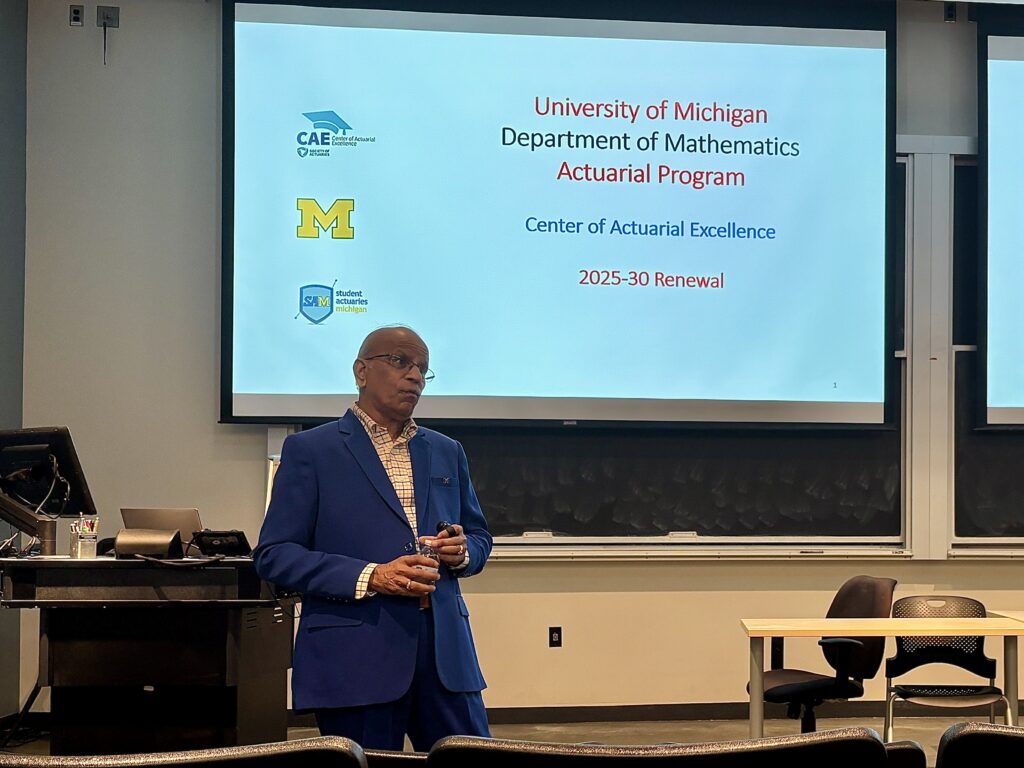
Now, over ten years into the position, Natarajan holds many roles and responsibilities in the actuarial department, including teaching, determining scholarships, mentoring students, and advertising the major itself.
What is an actuary?
On their website, the Society of Actuaries gives a concise description: “Actuaries measure and manage risk.” Actuaries mostly work for insurance companies–health, life, auto, and everything in between–but also find work in many other fields including banking, investments, government and so much more.
So what exactly does an actuary do? Brea Fried explains just that in an article from Etched Actuarial. On a simple level, insurance actuaries assess data from previous claims. Using claims data along with probability, statistics, and financial mathematics, actuaries determine how much money insurance companies should save to cover their losses for the next term. Sometimes, insurance actuaries also assist in pricing products, including working with underwriters to set premiums for certain insurance plans.
According to an article in The Actuary, Devadeep Gupta asserts that actuarial theory became working practice in 1762 with the foundation of the Equitable Life Assurance Society. However, he says that the actuarial practice itself dates back to 1750 B.C.E.–where legal codes reflect early attempts to quantify risk and compensation for losses.
Today, the job of actuary is ranked 5th in Best Technology Jobs by US News & World Report, with a median salary of $120,000. Additionally, the University of Michigan is considered a Center for Actuarial Excellence (CAE), one of less than 25 in the United States. This is awarded to recognize universities and colleges with outstanding actuarial programs and allow them to compete for grants for education and research.
However, not many students at the University of Michigan know of the actuarial major or even the career itself. There may be a reason for this. According to the two actuarial governing bodies, the Society of Actuaries and the Casualty Actuarial Society, as of December 2024 there are only around 45,000 credentialed actuaries in the entire world. In comparison, there are 653,408 credentialed accountants in just the United States.
But Natarajan says the field is growing now more than ever. “The awareness among the high school students is much, much better now compared to 20 years ago.” He says he even gets calls from parents of eighth graders asking about what courses their child should take in order to major in the actuarial field.
“It might take a while for people to understand, but once you fully understand the strength of the actuarial profession and what it can provide in the future, more and more people will take on the challenge.” Natarajan says.
Natarajan’s role at the university
Each semester Natarajan teaches two classes which involves organizing three hours of lecture each week, along with office hours, homeworks, and preparing exams. He also says his industry experience is especially helpful when teaching classes. “Instead of deriving a formula, instead of teaching a principle, you immediately tell the students, this is how this concept is applied in the real world.”
Natarajan also holds a role in the actuarial scholarship committee where he helps evaluate the students using a unique scoring system called the CEIL (Curriculum Exams Internships Leadership) score. Using this score, he is able to offer varying scholarships to almost every student in the major. “Last year we offered close to $550,000 in scholarships to close to 70 students,” he says, “so that takes a lot of time.”
Beyond the university, Natarajan’s primary responsibility is to bring awareness to high school students about the actuarial profession. Along with this, he works with smaller colleges and universities to help them move up in their actuarial classification, given by the Society of Actuaries. Additionally, he is now working with a prestigious institution in India, the Indian Institute of Technology, to establish an actuarial program there.
Finally, Natarajan is the official mentor for all of the actuarial students. “There are only 100 students in the entire program. And so, you have a close personal touch with every one of them,” he says, “I know every one of them by their first and last name.” In this mentor position, he aims to coach each student in four areas: academics, professional exams, industry experience, and leadership.
One way Natarajan aims to develop leadership is through the club Student Actuaries at Michigan, or SAM. With over 14 different board and leadership positions that can be held in the club, Natarajan hopes these opportunities can allow students in the major to mentor other students in passing exams, getting jobs, and doing well in classes. “Your leader is somebody who thinks about what is good for the whole community, everybody around them, not just himself or herself,” he says.
Mitchell Fuchs, President of SAM, says “the best part about working with Professor Natarajan is his clear understanding and vision for the growth of the actuarial math major.” After graduation, Fuchs hopes that the program’s momentum continues to grow, expanding the actuarial community that the university has created.
Vice President of SAM, Raegan Gothard echoes this sentiment, “if you’re an actuarial math major, you know Professor Natarajan,” she says, “you can see how much passion he puts into the program.”
Future plans for the program
As for his future plans, Natarajan’s main goal is to find someone dedicated enough to fill his shoes. “There are only 300 some people in the world with a PhD, FSA [Fellow of the Society of Actuaries], and with industry experience.” In working towards this goal, Natarajan has begun an endowment fund called the Actuarial Lectureship Support Fund. He hopes to use this to supplement the normal salary paid by the university in order to attract people from the industry—those who would be taking a large pay cut like Natarajan did.
Although searching for a replacement, Natarajan isn’t itching to step down anytime soon. “The close personal relationship day in and day out with all these students, that is the best part of my life,” he says.
Feature photo, Dr. B. Roger Natarajan giving a presentation; Photo Credit, Lexi Davis