
Bridging the Gaps, and Filling the Cracks
Zee Kennedy’s mission towards inclusion for adults with special needs
—By Zoë Bormet
At just 18, Zee Kennedy became her 26-year-old sister’s legal guardian in the span of ten minutes. A day earlier, she had received a phone call warning her that her sister had a court hearing the next day because the court-appointed guardian at the time intended to send her sister to a psychiatric facility immediately. When the judge asked if anyone present could take over guardianship, young Kennedy bravely stood and raised her hand. She left the courtroom with no guidance, no support, and no resources, left to navigate this new responsibility entirely on her own.
As Kennedy restructured her entire life and even shifted her career path to revolve around caring for her sister, she discovered that she was far from alone. There were many others like her sister, with families suddenly finding themselves responsible for navigating “systems that offered little help.” The challenges she faced inspired her to start a local nonprofit called Exceptional Journeys, a skill-building program in Washtenaw County dedicated to providing inclusive opportunities for individuals with special needs.
The gap after age 26
In Michigan, once individuals with special needs turn 26, they age out of public school services, often leaving them with no structure or support. Without guidance, individuals may not be able to live independently or provide for themselves, especially if their family does not have the time or financial resources to support them. She’s witnessed many families forced to give up their jobs and lose their homes to take care of loved ones. Many individuals with special needs also become homeless or live in isolation without integration into society.
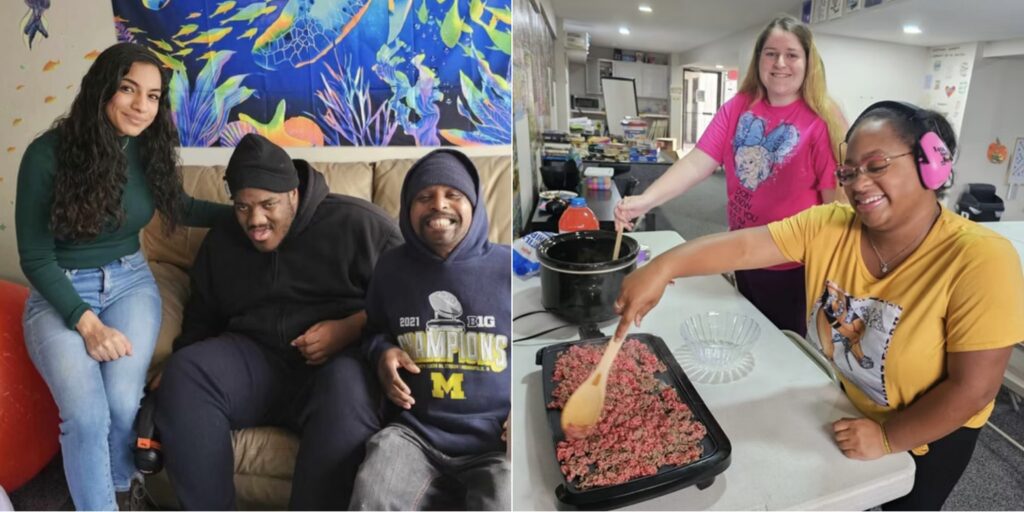
To address these issues, Exceptional Journeys provides a full day program for participants 18 and older with offerings including music, gardening, cooking, art, games, social groups, and community outings.
What began as one Facebook post quickly grew into something larger, as people reached out to get involved. Kennedy had begun running some small programs and they soon needed a roof over their heads, so the organization transitioned to a community center, located on Packard Street in Ann Arbor. As they expanded, she applied to contract with Washtenaw County, which provides funding, more clients, and awareness. Exceptional Journeys has now evolved to a skill-building program, which allows them to operate as a full day program.
The impact of inclusion
The monthly culinary classes and weekly visits to a local donut shop are big hits for clients like John, a member of Exceptional Journeys for the past two years. He recounts that after aging out of the system, it was the social interaction he missed the most. He states that the organization is so important because there’s truly not enough like it: “it brings people together. There’s a sense of community that we didn’t have before, but now we have it.”
For John, it was the simple things he longed for after high school, like the structure of waking up at a specific time. He explains that at Exceptional Journeys, “If you decide not to come, everyone else is going to miss you. If you need to leave early, you’ll be missed.”
John beams as he describes Kennedy’s influence: “Zee is incredible. The fact she started this with her sister, and she built it up from nothing to what it is now, she is amazing.” At Exceptional Journeys, John feels understood in ways he’s never experienced with other programs. Kennedy states, “it’s the cracks within the gaps, as I like to call it, that we focus on. It’s not just the gaps. It’s everything in between that people often just kind of overlook.”
Her impact doesn’t just focus on the individuals but also reaches beyond to their families. Kennedy believes that everyone’s biggest fear as a caregiver is, “what will happen to our loved one if we’re not here?” John emphasizes how inclusive they’ve been of his family stating, “that’s the greatest thing they do, reach out to the families and help them.” By creating this space, she has not only built a center that offers programs, but also fosters friendships amongst clients and their families. She offers parent support groups every Monday morning, where parents and guardians have built strong connections. Kennedy’s thought is, “if something were to happen to them, they know that they have each other to rely on.”
Challenging a broken system
According to Zee, the system “wasn’t built to support individuals throughout their entire lifespan. When you’re done with school, you’re on your own.” She explains that for an individual without any special needs, they graduate high school, move on to college, get married, and continue their life. But even when individuals with special needs graduate, they are not necessarily guaranteed to be eligible for services through age 26. Kennedy states that often these individuals with no family are left behind at group homes. They remain confined at home all day, with no transportation and nowhere to go.
The organization only receives enough funding and support to sustain the services they have, as they have not received a single grant. Before contracting with the county they relied entirely on volunteers and donations. However, even the county support is just enough to provide day program opportunities for their current consumers. Kennedy’s biggest challenge is limited resources. With the space they are currently operating in, the organization is limited in how many people they can accept. Kennedy notes that it gives people false hope, as the program fills up so quickly, leaving families back at square one. She notes, “families that desperately need support can be stuck on waitlists for years to gain services that organizations like Exceptional Journeys provide because demand is so high.”
During this time, caretaker mental health neglect can take a detrimental toll. She explains that “if the parents or guardians aren’t okay, they are left with very little energy to actually take care of their loved ones, and everything goes downhill after that.” Through accessibility and expansion, Kennedy strives to eliminate the waitlist, leaving no one behind.
Kennedy’s ultimate goal is to provide housing, job opportunities, and attention for supporting family members to ensure they are taken care of and able to function without additional stress. Her mission is to create a center where every single person that transitions out of the system immediately has a place to go.
Undermined by the Administration
In 1975, Congress passed the Individuals with Disabilities Education Act (IDEA) in response to public belief in the long-term benefit of educating children with disabilities, growing concern that states were not providing an adequate public education to these children, and a series of legal challenges. Paul H Lipkin and Jeffrey Okamoto writing for the Journal of Pediatrics estimate that 15% of children in the United States have a disability. IDEA entitles all individuals to a free appropriate public education through early intervention and special education services until young adulthood.
The demand for support is needed now more than ever. Alexis Weaver, Susan J Popkin, and Dana Ferrante from the Urban Institute states that 7.5 million students have an IEP; that’s more than 1 in 10 students in public schools in every state. With programs already severely underfunded, efforts to close the Department of Education at the hands of the Trump Administration will further restrict access to special education services.
Building the future
When asked about expansion, John stated, “I feel like it’s going to keep on growing. It has so much room to expand, not even just all over Michigan but everywhere.” He emphasized that “everybody that has a disability that’s straight out of high school needs this. We want it, we need it. Because there’s no other place that I know of that will take people after high school.”
Kennedy highlights that a prominent issue is that society “neglects those that actually need help, that can’t advocate for themselves. If they don’t have support to advocate for them, it’s easier to just deny services to them. Something right in front of you, someone so vulnerable that desperately needs you. But once again, people are just overlooking them.”
Kennedy argues that our mindset as a society must shift. Too often, people with special needs are seen through the lens of limitation instead of their potential. She explains that “many immediately assume because they’ve met one individual with a similar case that they’re all the same. If you actually take the time to get to know each individual, you learn to communicate like they do.”
According to Gary N Siperstein, Robin C Parker, and Max Drascher with the Journal of Vocational Rehabilitation, research shows that adults with intellectual disabilities face unemployment at more than twice the rate of their peers without disabilities, and many are paid below minimum wage. Yet those who are employed often demonstrate strong work ethic, reliability, high attention to detail, and long-term job stability, with many remaining in the same position for three years or more. This demonstrates that the disparity is not due to lack of ability, but rather a lack of inclusion.
In a world that too often overlooks the talents of the differently abled, Kennedy’s vision and action stand as an example for inclusion, empowerment, and lasting impact. Kennedy states that what makes Exceptional Journeys so special is that it’s not just for intellectual or physical disabilities, “but also those with mental health struggles or simply don’t feel that they fit in in the world; this is a safe place for everyone.”
Feature photo, Exceptional Journeys; Photo Credit, Zee Kennedy