
Finding Purpose Beyond a Paycheck
Restoring student-athlete engagement at U-M
—By Zoë Bormet
Just a year ago, student athletes raced to sign up for restorative yoga or financial literacy workshops provided by Michigan Athletics. Days after being released online, spots would fill up to capacity. Today, those events sit empty, with zero sign-ups. For years, Michigan Athletics has also maintained a rich history of giving back to the community. However, it is evident that there’s been a stark decrease in student-athlete engagement.
The ripple effect of NIL
In 2020, former college athletes filed a class-action lawsuit challenging long-standing NCAA rules that barred players from profiting off their own name, image, and likeness (NIL). A year later, in July 2021, the NCAA lifted those restrictions, opening the door for student-athletes to earn money through endorsements, merchandise, and sponsorships. Simultaneously, the Supreme Court ruled in Alston v. NCAA that the NCAA could not limit education related benefits provided by universities, allowing schools to offer academic incentive payments.
But for many former players, these changes came too late; they wanted compensation for the years their labor generated millions in revenue for schools and companies, while they earned nothing outside of academic scholarships, if even applicable as there are limited scholarships available.
That call for restitution culminated in House v. NCAA, a landmark $2.8 billion settlement approved on June 6, 2025. The agreement not only compensates past athletes but also allows schools to share up to $20 million annually in revenue directly with players beginning in 2025. For universities like Michigan, this represents one of the most dramatic shifts in the financial landscape of college sports.
Funds that once supported academic incentives and personal development programs now must be redirected to cover athlete compensation and expanded scholarships. While the settlement marks progress in recognizing athletes’ economic rights, it has also produced an unintended consequence: declining student-athlete participation in educational and community engagement programming.
A system upended
Before the settlement, Michigan Athletics offered the Alston Academic Award Program, which provided eligible student-athletes up to $5,980 per year for attending at least 6 program events with distribution requirements including financial literacy, leadership development, career preparation, health and wellness, and community service. Following the House ruling, Michigan discontinued the program for the 2025-2026 academic year, reallocating more than $6 million toward 82 new athletic scholarships to comply with the new financial model to reallocate funds due to the House settlement, revenue sharing, and increased academic scholarships.
As both a student-athlete and community engagement lead, I’ve seen firsthand the double-edged impact of this transition. While new scholarships expand access and equity, they’ve also uprooted the structure that once encouraged personal growth and connection beyond sports. In this increasingly transactional era of college athletics, the challenge isn’t just funding, it’s motivation. How do we reignite student-athletes’ intrinsic drive to learn, volunteer, and grow when the incentive that once encouraged those habits has disappeared?
The numbers behind the decline
The numbers tell a clear story, according to Brian Townsend, the Director of Leadership and Student-Athlete Development at the University of Michigan. “We’re getting only about 20% of the total number of participants that we had in the last two years at each event,” Townsend said. Prior to 2021, “before the Alston money, participation was around 30-35%. With the Alston money, it jumped to 70% and within that, 60-65% were women.”
What makes the decline even more surprising is that athletes consistently reported high satisfaction with the programs. Townsend said that in last year’s feedback survey, 99% of athletes said they learned something they could use immediately, 97% thought it was a good use of time, and 98% would recommend the program to a teammate. “So while the feedback was positive,” Townsend reflected, “we’ve conditioned student-athletes for the transaction more so than the transformation.”
Value in giving back
Beth Nichol, Rob Wilson, Angela Rodrigues, and Catherine Haighton, writing for the Springer Nature, found that engaging in volunteering correlates with reduced mortality, improved functioning, better mental health, greater social connection, and a stronger sense of purpose. For the Michigan head wrestling coach Sean Bormet, community engagement has personal meaning beyond the rewards or requirements. “Taking two hours out of my day to go to an event and seeing the impact it has on people actually gives me a lot,” he said. “After that, I’m more energized, and I just have a different energy and perspective on why we’re doing what we’re doing. It keeps things in balance, which is really important, because it’s easy to get out of balance these days as a coach or a student-athlete.”
The cost of incentives
To Townsend, the introduction of financial incentives fundamentally shifted student-athletes’ motivations. “Before athletes were paid, they could see the transformational opportunities,” he said. “Once we started giving the money, there were more people there for the transactional experience than the transformational one. We’ve trained this cohort of kids to expect compensation.”
Bormet sees this shift as part of a broader challenge. “Incentives are tricky,” he said. “There’s moral, financial, and social or professional incentive to do something, and ideally, those align.” When the Alston money existed, Bormet said, “it made a perfect alignment with the moral part of that incentive.” But now, he feels, “the financial incentive has been removed, and the moral incentive hasn’t necessarily recovered. The social and professional incentive hasn’t yet reattached itself to the moral part.”
He reflects that the original intent behind the Alston money was positive, to motivate student-athletes to engage in activities that benefited their growth. “When it started, I don’t think anyone really anticipated such a significant change or that legislation would move so quickly and drastically reshape the financial model of college athletics,” Bormet said.
A culture rebuilt
Townsend is optimistic that athletes will eventually return to the habit of giving back, but not without guidance. He sees peer-to-peer influence as the most powerful force for restoring engagement. “I think people will look back and be like, ‘oh, man, I could have done more last year,’” Townsend said. “And I think we’ll see that more next year. But again, it’s going to have to be peer to peer, with coaches also helping.”
Bormet shares a similar view, suggesting that participation will rebound through the right social incentives. “It starts with the right athletes, the ones who have influence within their teams to create that vibe at those events,” he said. “Then more and more athletes will want to go, and that’ll start to align with the moral incentive of creating impact for the community.” He added that before the Alston payments, coaches routinely emphasized the value of community involvement. However, once financial incentives were introduced that message lost some of its power. “Now we have to go back to coaches, captains, and team leaders pushing these events and highlighting the positive benefits of participation,” he said.
Still, he remains hopeful. “I think this is a moment, it’s temporary,” he said. “Over the next several years, I think there will be corrections to rules, and more and more kids will reconnect intrinsically with wanting to do community engagement.” Matt R. Huml, Meg G. Hancock, Mathew J. Bergman, and Mary A. Hums, writing for Social Science Quarterly, found that student-athletes performed more community service if they independently chose their community service activity instead of the athletic department.
In Michigan’s Student-Athlete Development office, Assistant Director Ashley Korn is now recalibrating how to engage athletes without financial incentives. “Things are going to have to be more hands-on, like they were before all the Alston changes,” she said. “It’s going to take the full support of coaches and staff to get students invested again. We just have to do it differently, make it more individualized. It’ll take some time to get our feet under us, but ultimately it’s going to require more effort from the full-time staff to get student-athletes involved in the opportunities that will serve them the most.”
NIL may be the cause, but also the solution
One possible solution may be to reframe programming in a way that aligns with the world of NIL. Bormet thinks this connection could help athletes see community engagement as part of building their personal brand. “With NIL, student-athletes are starting to view themselves as entrepreneurs,” he said. “Doing things that impact the community helps build your brand more broadly and actually increases your social media presence. I think there will be a point where the moral incentive to do great things aligns with the social and professional incentive, creating new financial opportunities athletes can build for themselves.”
Korn echoes that the key to increasing participation lies in how these opportunities are presented. “To get students invested, you have to show them how this benefits their brand,” she said. “At a place like Michigan, every sport has leverage when it comes to building a brand and image.” She adds that programming needs to be intentional and student-driven to regain traction. “We have to make sure we’re giving student-athletes a voice in what they want,” she said. “One reason engagement may be lower now is that the menu of options doesn’t always fit their interests, and that’s going to change every year.”
Keeping Michigan’s spirit alive
For Korn, the deeper goal is preserving Michigan’s sense of community and pride. “We want everyone to be invested in and love Michigan the way they need to in order to want to stay here,” she said. “That’s a dying aspect of college athletics. But Michigan isn’t a place you can just show up to and not get invested in. People come here because they love it. Everyone jokes that Michigan’s a cult, it kind of is,” she added with a laugh. “You can’t come here and be transactional; it doesn’t work that way. And if you try, you probably won’t last. It takes effort from everyone to make sure people aren’t just here for a transactional reason.”
Despite the challenges, Korn remains optimistic. “It’s a lot of work, but that’s okay,” she said. “We’ve embraced it. This isn’t just a Michigan problem; every university is struggling with it. So we can all share in the experience that this is hard, and it will be, until the NCAA continues to make decisions that keep shaping how we do things.”
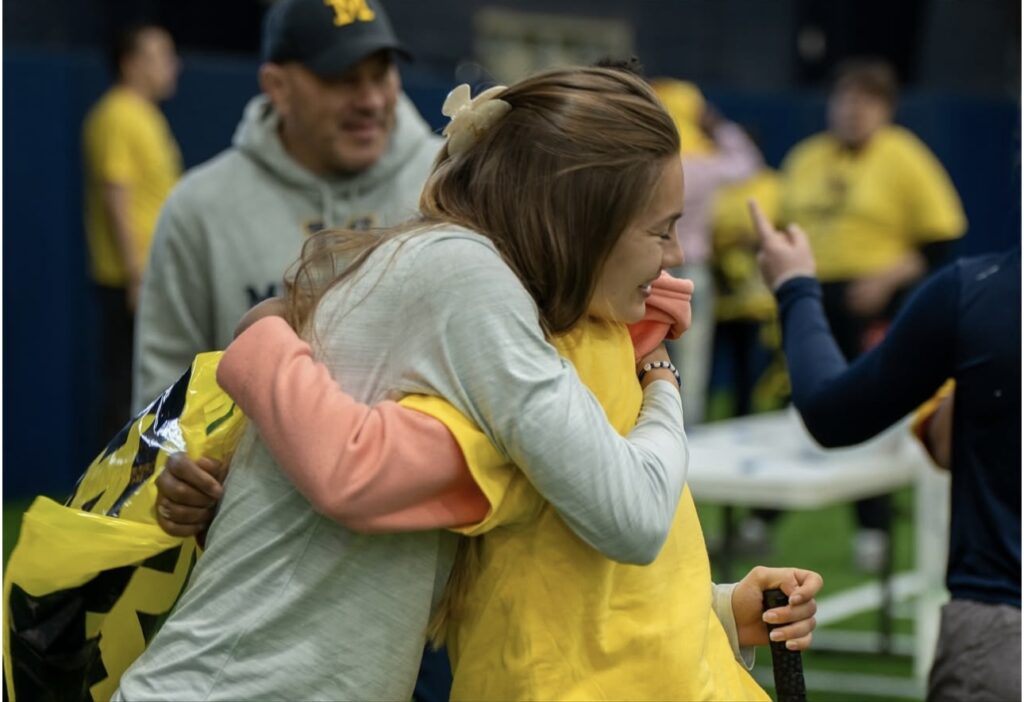
Feature photo, Victors Day; Photo Credit, Michigan Athletics