
Between the Curb and the Cause
How parking changes are reshaping accessibility and daily life downtown
—By Lauren Thompson
It’s a quiet Tuesday morning as Bill Stolberg walks three blocks from his car to open his barber shop on South State Street. The door softly jingles, and the smell of aftershave mixes with a faint candle burning on the counter. The room is small and cozy, two worn leather chairs, a narrow mirror, and sunlight slanting through the window on the retro blue walls.
Behind the chair, Bill trims the hair of a customer who biked there and left his bike parked in one of the designated bike parking spots. Bill says mornings are easiest; later in the day, drivers start circling for spaces that no longer exist. He has worked there for fifty-one years and remembers a completely different layout. “In 1974, there were meters on both sides of the road,” he says. “Meters create revenue, so the change makes no sense to me.”
For him, and for many nearby shop owners, the city’s redesigns have reshaped more than traffic patterns. They’ve altered the rhythm of daily business: who visits, how long they stay, and whether they can even find a place to stop.
Progress at a price
Ann Arbor’s new bike lanes and reduced curbside parking reflect a broader effort to balance sustainability with accessibility. City Planners argue the shift will reduce carbon emissions and improve safety, but for long-time business owners like Stolberg, those ideals collide with day-to-day practicality.
The city’s Vision Zero plan, adopted in 2020 to eliminate traffic fatalities, called for expanding protected lanes and narrowing car corridors. According to the City of Ann Arbor Crash Reporting data, serious or fatal bicycle crashes fell from four in 2023 to three in 2024. Pedestrian injuries remained the same with 11 serious injuries and one fatality in both years. Officials consider the stabilization progress compared to pre-design years, when pedestrian severe- injury totals were higher.
According to the Downtown Development Authority’s “People-Friendly Streets” Phase 1 summary, more than 70 on-street parking spaces were removed across the State-Liberty corridor during the first phase of the redesign. Many of these removals occurred on blocks where businesses rely heavily on quick drop-offs and short-stay parking. The DDA notes that curb extensions and wider pedestrian areas replaced most of these spaces in an effort to calm traffic and improve crossing safety.
Yet for businesses that depend on easy curb access, the transition has brought friction. Parking meters disappeared, curbs were reshaped, and delivery drivers lost short-term stopping zones. “It affects older customers and people with mobility challenges the most,” Stolberg says. He notes that customers from Saline and Dexter who once could park easily nearby now struggle to reach his door.
A 2021 Transport Reviews study by Jamey M.B. Volker and Susan Handy found that while walk— and bike— friendly infrastructure can benefit cities long term, small businesses often see short-term losses during the transition. The key, authors note, is adaptation rather than resistance.
The everyday juggle
Down the block at Pizza Bob’s, manager Pam Pietryga describes a similar struggle. “Delivery drivers have nowhere to park, so I’ve been running orders out to them,” she says. It’s not ideal, and it’s not safe. Cars double-park with their hazard lights flashing, as employees dart between bikes, scooters, pedestrians, and cars to hand off food. Still she says, it is what they have to do to keep orders moving.
Stolberg has noticed the same pattern. “It’s driven away a lot of customers, especially the ones nearby and from surrounding towns,” he says. Michigan’s four seasons, he adds, make the city’s year-round bike vision difficult to maintain and out weigh the benefits. Explaining that during winter months customers find it “too hard to navigate parking,” and there aren’t that many bikers anyway.
During winter months, protected bike lanes narrow further as plowed snow and slush settle into the buffer zones. The DDA notes in its winter maintenance brief that standard plows do not always fit new lane configurations, leading to inconsistent clearing. This makes navigating the area more difficult for both drivers and pedestrians and decreases curb accessibility during the months when most residents rely on cars.
The city’s rationale remains ambitious. According to a University Wire report, Ann Arbor’s protected bike lanes began as part of the city’s “People Friendly Streets” initiative, led by the DDA to improve safety and accessibility. The intention is noble— safer, greener streets— but the rollout has made visible the clash between the two kinds of accessibility: environmental and economic.
Community feedback collected during the 2023 People-Friendly Streets outreach shows that pedestrians, cyclists, and bus riders have experienced the redesign differently. Pedestrians reported appreciating the shorter crossings and slower turning speeds at intersections, but many said they were unsure of where bikes and scooters were expected to yield at mid-block crossings. Cyclists highlighted feeling safer riding downtown for the first time due to the physical separation from cars. Bus riders noted that new boarding islands improved safety but relocated stops created longer walks during winter months. These everyday trade-offs shape how different groups move through the corridor.
Progress meets population
Professor Greg Dooley, a lecturer in the University of Michigan’s School of Education, sees the shift as part of a much larger pattern. “Ann Arbor’s population is growing, he explains. “We’re seeing more students, more walking, more scooters, more bikes.”
Dooley believes the city’s transportation identity is evolving. “There’s a larger question here about how we design spaces for density. It’s not just about bikes; it’s about fairness and safety across all forms of mobility.”
DDA downtown entry counts show a slight decline in weekend vehicle traffic since the redesign. At the same time, pedestrian counts rose during the same period. The shift indicates that some drivers, especially visitors from non-campus neighborhoods, may be avoiding the corridor.
He also acknowledges that transitions like this create friction. “It would be nice to have more accessible parking in areas like State Street,” he says, “But planners made a choice not to prioritize parking. I think someone should be studying that.”
His observation aligns with findings from a report by CTECH, a research lab at Cornell University, which found that reduced parking access in University towns can discourage nonlocal visitors and unintentionally make downtown cores feel less welcoming.
Balancing progress and practicality
For city officials, the short-term disruption is part of a necessary transition. The city’s Climate Action Plan calls for halving emissions by 2030, and transportation remains the largest source. But for small business owners, policy goals can feel abstract. Several said they were not consulted in ways that reflected the realities of daily operations and delivery logistics.
City Council minutes from 2024 show that multiple business owners expressed frustration that outreach efforts did not adequately include them during planning. In response the DDA began hosting business-listening sessions though turnout varied, leaving some blocks more represented than others.
A 2025 Michigan News Source report, “Park in a Bike Lane? Ann Arbor’s Now Watching,” describes new enforcement measures, digital ticketing and increased fines for vehicles stopped in bike lanes. Some residents support the stricter rules, while workers who rely on curb access say they add stress to ordinary tasks.
Multiple delivery drivers reported to the city council the ticketing system can issue fines within seconds, making even brief stops risky. Many urged the city to expand loading zones and adjust their hours to align with peak delivery times.
Stolberg’s preferred fix is modest: “Put meters on at least one side of the street. There’s no reason not to.” For him, restoring even limited parking could balance safety with accessibility.
What the data shows
Car travel times through the State-Liberty corridor did increase modestly after the redesign, according to the DDA’s 2023 People-Friendly streets mobility summary, which found slower vehicle throughput at several intersections. A 2024 MLive review of downtown business trends also reported that many merchants noticed slower lunchtime traffic compared to pre-redesign patterns.
Economic research remains divided. Transport Reviews conclude that bike friendly redesigns can boost long-term spending once patterns adjust, but that businesses without foot-heavy storefronts may struggle longer. In Ann Arbor, this tension is visible on State and Liberty Streets, where some curbs now have no parking at all.
Living the change
Residents from nearby towns like Dexter and Chelsea told Stolberg they visit less often because downtown errands take longer now. For people with mobility needs, the loss of front-door access matters even more.
Several attendees at the 2024 Vision Zero open house emphasized that curb access is “not a luxury” but a necessity for older adults and people recovering from injuries. One resident noted that walking “even two blocks” from a parking garage was no longer feasible after a recent surgery.
Students have mixed reactions too. Students interviewed during the DDA’s 2023 People-Friendly Streets outreach said the redesign made biking feel safer but also noted that the mix of scooters and e-bikes in the protected lanes could feel unpredictable during busy class-change periods. Several also said they now avoid driving downtown during the school year because parking “isn’t worth the hassle,” choosing instead to walk or ride the bus.
Dooley notes that while cycling has increased, scooter congestion and awkward layouts create new conflicts. “It’s a shifting ecosystem,” he says. “We’ve solved one problem but created another.”
City transportation staff stated in 2024 that community feedback reshaped later redesign phases. New “access loading zones” were added near major intersections for passengers with mobility needs. However, their limited number and inconsistent enforcement hours remain concerns raised by students.
Dooley argues that design should respond to behavior rather than dictate it. If accessibility declines, he says, it should prompt a review of what accessibility truly means in practice. “I used to pull up at Mr. Spots, grab my wings, and go. Now I don’t do that anymore,” he says.
A growing divide
At Pizza Bob’s, the midday pace is slower than it used to be. Through the window, Pietryga watches the street while she rolls out dough. She has watched the corner of State Street change for more than sixty years. What was once a steady rhythm of regulars and quick lunchtime stops has slowed to a trickle. “It’s heartbreaking for me,” she says.
Urban sociologists describe this kind of shift as a form of symbolic displacement; changes to the built environment subtly alter who feels welcome in a space, even if no one is formally excluded.
Ann Arbor’s charm has always been it’s balance. A small-town feel paired with progressive ideals— but some locals feel that equilibrium slipping. Bill reflects on it quietly between appointments. “You used to know everyone and they could park out front,” he says. “Now I see more scooters than bikes.”
The road ahead
As Ann Arbor continues to expand it’s network of protected lanes and pedestrian zones, the challenge is not only technical, it’s human. Each curb, meter, and painted stripe decides who has access to public space and how they reach it.
Residents at recent transportation forums urged planners to evaluate accessibility outcomes, not just safety statistics. Many advocated for periodic adjustments based on the lived experiences of those who navigate downtown daily.
For small business owners like Pietryga and Stolberg, the question isn’t whether sustainability matters; it’s how to sustain community within it. For the residents, the daily search for parking or safe crossings has become the quiet rhythm of a city in transition.
Several residents at the 2024 Vision Zero open house said the changes have made basic errands more time-consuming. One attendee described avoiding downtown on workdays because “it takes twice as long to get through State Street now.” Another said the loss of the quick curb access has pushed more people into garages even for two-minute pickups.
Dooley suggests studying accessibility outcomes and testing hybrid solutions. “Urban improvement should not mean erasing what works,” he says “It should mean learning from those who live it.”
Dooley believes the challenge is not choosing between cars and bikes, but figuring out how to design a system that works for both. “Urban streets always reflect the people who use them,” he says. “The question is whether we’re listening closely enough as that changes.”
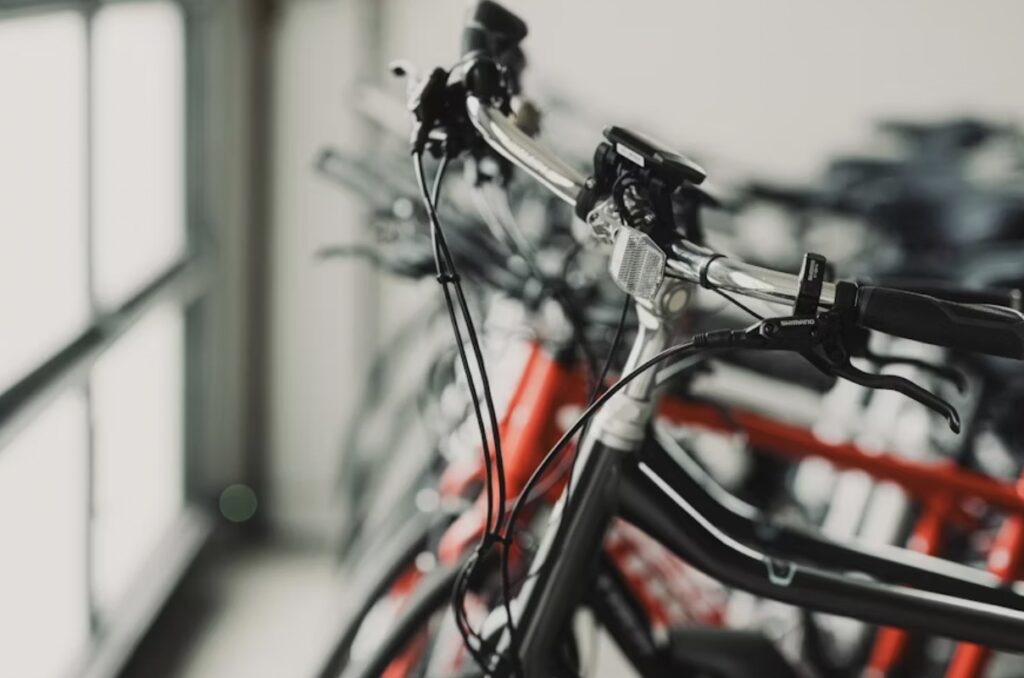
Feature photo: Bikes, by Gilley Aguilar on Unsplash