
More Than Miniature
How bonsai at Matthaei nurture both the planet and our own sense of calm
—By Emma Kill
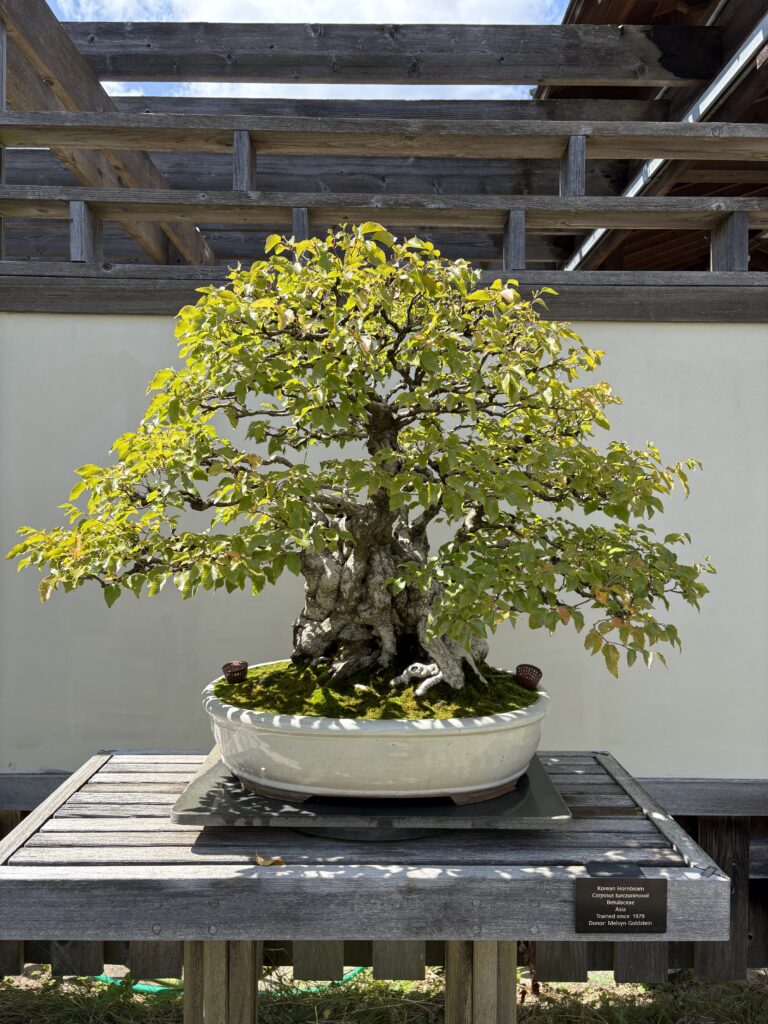
Within Matthaei Botanical Gardens lies a bonsai garden where many species of trees are arranged with deliberate precision and care. Every branch is uniquely wired with every leaf or pine needle carefully trimmed. Without the devotion of the bonsai gardens caretakers, these miniature trees wouldn’t be so miniature anymore.
Unique to their collection of bonsai are their 36 azaleas, all blossoming in the months of May and June. These bonsai showcase their vibrant colors and beauty, Carmen Leskoviansky, the Arboretum’s Collections and Natural Areas Specialist highlights. But that’s not all; with its tranquil beauty, the bonsai garden offers a serene escape from the noise of the world; especially a city like Ann Arbor. “It’s a really special way to interact with nature in the city that’s very busy and focused on other things,” Leskoviansky emphasizes.
Bonsai technician Mike Bruneau explains the bonsai in their collection are extending a warming invitation to their visitors in their orientation. With the gentle dip down of a branch and the other reaching slightly upward, and the slight lean towards you, “It’s welcoming you in… It says, ‘hello.’”
History of bonsai
Bonsai formally originated from the Chinese practice of pening—meaning “potted scenery”—in the 7th century. The original aim was not to represent nature perfectly, but rather amplify its beauty. By the 12th century, the art was adopted by Japanese monks and craftspeople, evolving into how the world views bonsai today—an imitation of nature on a small-scale level. “Bonsai depicts a version of a tree existing in nature and uses its subtle details to tell stories,” as Leskovianky describes. By arranging them in a specific way, Bruneau takes the tree’s best qualities “to create a stylized, nearly identical representation.”
Only having been introduced into the United States within the past century, bonsai has taken on a new depth through inclusion of other tree species. For example, North American species have become part of the art form, expanding beyond Japan’s favored species. You can see this bridge between American landscape and Japanese origin at Matthaei. If you take a stroll through the bonsai garden, you’ll find a Rocky Mountain Juniper, a native tree to North America.
The care of the garden
The bonsai in Matthaei’s collection were all donations from prior caretakers. Leskoviansky reflects on how each tree is an imprint of its past keepers, prompting questions such as: “What was their vision? How do I continue that vision or choose a new direction?” In this sense, tending to the bonsai becomes less about ownership and more about honoring continuity. “It’s like a legacy of care over time,” says Leskoviansky.
With that care comes a great deal of attention. Bruneau says that the process isn’t magical. Bonsai trees are living things that want to naturally grow into full-sized trees, but you need to contain them by guiding their growth. It is a step-by-step process that requires consistency and diligence, something of which Bruneau has learned along the way. Some people may interpret that as tedious and a test of patience, but “if you love what you do, you don’t need patience.”
Through further reflection of the care devoted to the bonsai garden, it must be understood that each tree is unique. Tending to them can vary depending on the type of surveillance they require, Leskoviansky explains. Young trees are in a demand for more care, just as a child would. This means more frequent watering, generous feeding of fertilizers, and selective pruning to guide their structure. The more mature trees have shifted into a state of steadiness where they don’t require the same amount of care. Most of the trees will receive two major prunings each year in the spring and fall, while others like the blossoming azaleas will also require their buds to be removed to prevent seed growth. Beyond that, the branches of the trees are wired and shaped, keeping close attention to not scar the tree; detailing the ongoing collaboration between the tree and the grower.
The calm behind the craft
The first thing you may notice as you enter the garden might not initially be the trees themselves; it’s the silence. For many visitors, the garden becomes a place where time slows down. As a family enters behind me, their voices drop to a low whisper as if they stepped into a library, not a garden. Their admiration for the garden was apparent as they sat quietly and observed.
There’s a link that exists between nurturing bonsai and mindfulness, helping people feel more connected to themselves and the world around them. For many, it is a welcome outlet for their stress and worries. A study, “Bonsai: ‘A Life in Balance.’ The Therapeutic Benefits of Growing Bonsai Trees,” found that tending to bonsai was associated with reduced anxiety, better focus, and the deepening of connection to nature. The intense relaxation it brought to the people included in this study often reported having mental clarity. One particular participant described their experience as “a state of stillness.”
In a provided journal located in the garden, guests are able to reflect upon their visit. They are encouraged to share their thoughts and feelings in the company of the trees. These journal entries often include drawings, observations, and expressions of gratitude, demonstrating visitors’ connections to the natural world. With the quick turn of a page, guests are able to read how the garden touched others in the past, sharing a collective serene experience.
So, if quiet and warmth is what you need every so often, then it’s worth the short trip to ease a restless mind.
A deeper appreciation for bonsai
The bonsai displayed in the garden are not only there for show, they are there to challenge a stronger understanding of the environment. Both Leskoviansky and Bruneau want their visitors to leave the garden with a new appreciation for the trees all around them. It is easy to overlook the wonders of nature and forget the significant impact it plays on our everyday lives. By seeing it represented in a small, more focused way can spark a deeper admiration in visitors for their surroundings.
Bruneau hopes the garden evokes wonder and encourages people to think about their role in maintaining and preserving the natural world. He emphasized that without the care from us, more of it could be lost—“not just bonsai, but entire forests.”
Feature photo: Bonsai at Matthaei Botanical Gardens, Photo Credit, Emma Kill