
Erasing the Entry Level
How AI has transformed the first steps of the career ladder
—By Lexi Flores
“Graduation is just six months away. My GPA is good. I did all the things I was told to do: internships, clubs, cold-calling—you name it. And still, I have no jobs lined up for next summer.”
This experience from Savannah, a senior studying Economics at the University of Michigan, is unfortunately not unique. We have grown up with a distinct idea of how life is supposed to work out: go to school, get a job, work your way up, and live happily ever after, right? Not so fast.
Across industries, AI is taking over the kinds of tasks once entrusted to interns and fresh graduates. It writes reports, screens resumes, answers calls, drafts contracts, and more. A Stanford study has found that US employment for early-career employees has decreased significantly in recent years, sparking hundreds of more reports that have reached the same sad conclusion. For university students looking to enter the workforce, the rules of starting out have begun to change, and no one seems entirely sure what it will look like.
The evolution of AI
As I’m sure we have all seen, AI has completely transformed in recent years. According to the 2024 AI Index Report, “AI has surpassed human performance on several benchmarks.” For example, the 2025 AI Index Report demonstrates that AI performance has continued to improve. In 2023, AI systems could solve 4.4% of coding problems on the SWE-bench. In 2024, this number skyrocketed to 71.7%. Furthermore, investment in AI has reached an all time high in the United States, growing to $109.1 billion in 2024.
Beyond efficiency, AI has become more affordable and accessible, rapidly lowering barriers to its adoption. Research also shows that it can boost productivity and help narrow skill gaps across the workforce. Yet as AI advances at an unprecedented pace, these gains increasingly raise concerns that productivity improvements are shifting into outright job replacement.
Together, these factors have fueled a new business model: investing in AI rather than hiring employees who require training, benefits, and time to develop. For many companies, automation is simply more cost-effective than adding staff.
Allan Afuah, Professor of Business Strategy at the University of Michigan, is concerned about what this means for businesses and workers alike. He understands the appeal to companies of reducing costs to increase profitability. However, he also recognizes that in the long term, removing entry-level jobs will only strip employees from being able to acquire the skills and perspectives learned by working from the ground up. How could we be expected to work effectively as mid-level professionals with no prior experience? In an article by the Harvard Business Review, Amy C. Edmondson and Tomas Chamorro-Premuzic outline the damage that the disappearance of entry-level jobs will have. One such peril is the inability to fuel innovation. “Unlike AI, which delivers consistent outputs, humans introduce variability, which is sometimes messy but often the source of new ideas, improvement suggestions, and occasional breakthroughs,” aspects all integral to business growth and success.
Real students, real stakes
Like previously mentioned, Savannah is not alone in her struggles. Many of her classmates echo the same anxiety surrounding the job hunt. “Every job I apply to either requires years of prior experience or says that they have automated the position I was hoping for,” says Audrey, a senior pursuing a degree in Business Administration. “It feels like I’ve missed my chance before I even started.” Last summer, Audrey applied to over thirty internships. She spent hours perfecting her resume, attending networking events, and sending follow-up emails. In the end, she received one interview. Halfway through, the recruiter admitted that the original position of interest was no longer available as AI had taken over most of the tasks the role once required. “It was incredibly frustrating,” Audrey recalls. “I was willing to learn, but they didn’t even need someone to train anymore. The job itself just didn’t exist.”
For some, the issue isn’t finding a job—it’s what happens after landing one. Daniel is a recent graduate who managed to land a job at a consulting firm. As an intern for this company, Daniel spent his summer doing the classic entry-level tasks discussed earlier. However, during onboarding, the company expressed that AI systems will be completing many of these tasks when he starts after graduation. “I was thrilled to finally get an offer after months of applying,” he explains, “but this whole AI thing just makes me wonder what I’m actually going to be doing day to day. Am I going to be expected to know more than I do?”
These two experiences emphasize a growing divide among young professionals. Some can’t find work because AI is filling the entry-level roles they are applying for, while others worry they won’t be able to keep a job as AI continues to consume tasks traditionally reserved for new employees. The result is an uneasy feeling of limbo: students do everything that they were told they were “supposed” to do, yet these exact guidelines are shifting beneath their very feet. Career centers are left scrambling to provide guidance that stays relevant, while professors and mentors admit they don’t have a clear answer either. “We’re preparing students for a job market that’s changing faster than our syllabi can,” admits Afuah.
What businesses should do
Junior roles are too important to be erased from the workforce. They prepare the younger generation to move up the career ladder, fuel innovation, and foster organizational culture. Without them how will young adults find their purpose, structure, and belonging in a working world?
Edmondson and Chamorro-Premuzic believe that the solution is to redesign entry-level jobs to be able to withstand the AI-powered workplace. Junior roles cannot be defined by “repetitive, automatable tasks that AI can do better and faster… They should be designed to expose people to the why behind the work.”
In an article in Forbes, a McKinsey report estimates that “up to 60% of current jobs will require significant adaptation due to AI.” With that said, in order to keep humans in the workplace, it is important to hone in on the 40% that can’t be automated. Businesses should be investing in creating entry-level jobs in fields that can be helped by AI, not replaced by it.
What students can do
Students at the beginning of their job hunt journey have the opportunity to consider other fields by taking this information into account. For example, students can start by researching positions in AI-resilient fields like healthcare and education. Industries that rely heavily on empathy, ethical judgement, and human connection seem to be relatively safe from this automation trend.
That being said, adapting doesn’t mean abandoning technology altogether. As previously mentioned, AI has been proven to increase productivity in the workplace. However, effective use of generative AI still requires critical thinking and professional judgment. Studies note that relying on AI-generated outputs without evaluating them can lead to lower-quality results compared to individuals who perform the task independently. Current literature emphasizes that the value of AI lies in its integration with human decision-making rather than its use as a standalone solution.
Consequently, analysts highlight that skills such as critical reasoning, problem formulation, and clear communication remain important differentiators in the job market. Research continues to identify leadership, collaboration, and emotional intelligence as competencies that retain their importance even as generative AI systems become more advanced.
Looking forward
While the path ahead may look uncertain, it isn’t without promise. Although AI has disrupted the traditional career ladder, it also offers an opportunity to rethink what meaningful work looks like. In an article by Matthew Law and Rama Adithya Varanasi, businesses are increasingly delegating repetitive, low-value tasks to AI, allowing young professionals to be empowered to lead with creativity, leadership, and problem-solving from the very beginning of their careers. The challenge lies in learning how to collaborate with AI rather than ignore it; AI is here to stay and will continue to infiltrate the workforce.
Universities are responding by incorporating AI literacy into their curricula, giving students a space to understand the technical and ethical dimensions of this ever-adapting tool. Meanwhile, forward-thinking companies who worry about their future working class size but recognize the value in AI are starting to pair new hires with a designated AI “mentor.” The hope is that instead of erasing opportunity, this shift will redefine it.
For this generation of soon-to-be graduates, uncertainty has become the new normal, and resilience the new requirement. The coming years will reward those who can adapt, think critically, and lead with empathy rather than fear. We must bring humanity to the spaces technology cannot reach. “AI isn’t going anywhere,” Daniel reflects, “so I’m trying to figure out where I fit alongside it—not behind it. I just hope companies remember we still need a place to start.”
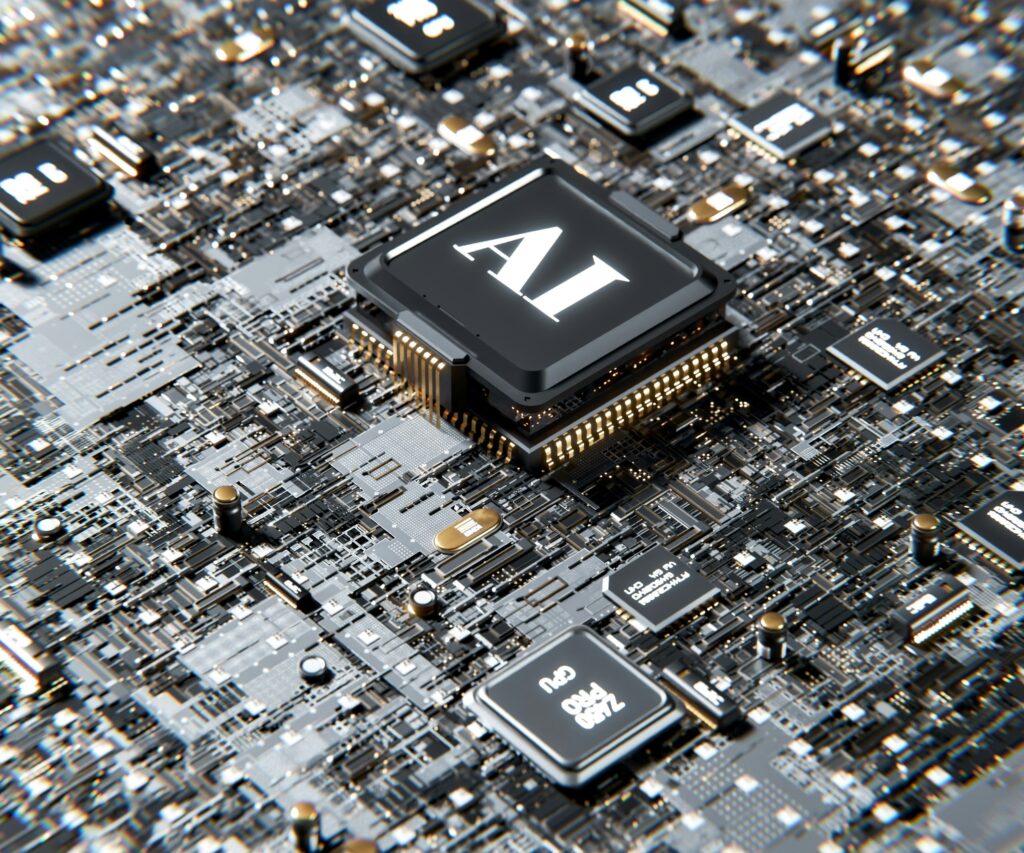
Feature photo, 3D render of AI processor; Photo Credit, Igor Omilaev on Unsplash