
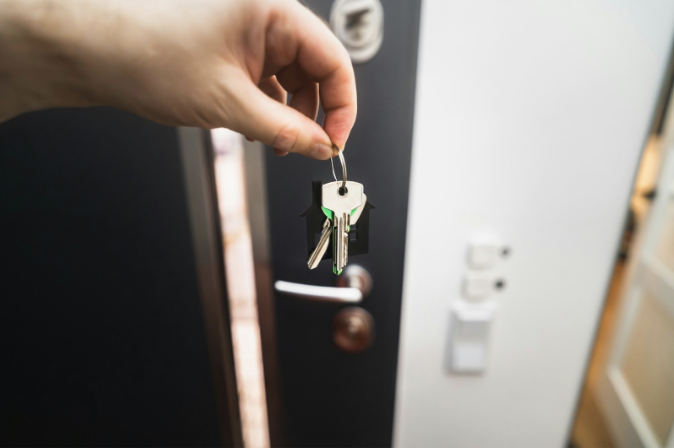
The Price of Proximity
Sky-high rents and limited supply make Ann Arbor’s housing search a stressful scramble
—By Isabela Fernandez
During her first semester of her freshmen year at the University of Michigan, Abby Davidson should have been focused on midterms and football games. Instead, she spent her nights hunched over her laptop scrolling through apartment listings, weighing options, and discussing high rent prices with friends she’d only just met. Buildings near campus were filling fast, and prices seemed to rise by the week. Long before she’d settled into campus life, Abby was learning one of Ann Arbor’s harshest lessons: in this college town, finding housing for next year starts before you’ve even unpacked for this one.
With limited space and luxury apartment buildings dominating the market in Ann Arbor, students are left scrambling to find affordable options near campus. Ann Arbor’s average rent for an apartment, according to RentCafe, exceeds $2,000. In September of 2025 NBC ranked Ann Arbor as the eighth most expensive college town in the nation. Renting a studio or one bedroom apartment may be less expensive, but two or three bedrooms fall above the $2,000 average. Students say the search for housing has become a stressful and defining part of their college experience. The University hopes new residence halls and upcoming high-rise projects will ease the strain, but for now, the pressure shows little sign of letting up.
High prices, low options
For students, the increase in rent prices translates to unfortunate trade-offs. “My friends at Michigan State or Grand Valley paid almost half of what I did and had double the amount of space, said recent U-M graduate, Sabrina Yousif.
“In Ann Arbor, it has felt like you’re paying for the name rather than the quality.” Many of the newest developments—sleek high-rises with rooftop decks and study lounges—advertise themselves as “luxury student living.” But these buildings, like The Verve, often come with rents well above the city’s already high average, doing little to address affordability concerns. For most students, that means choosing between paying premium prices for proximity to campus or moving farther away and sacrificing convenience.
Luxury apartment construction is continuing with new builds across the city. An article from Multifamilydive describes the construction of a 625-bed apartment complex to be called Chapter Ann Arbor. This high-rise building will offer study lounges, a private library, units stocked with stainless-steel appliances and quartz countertops, all within a block of campus. Chapter Ann Arbor is set to finish construction before the start of the 2027-28 academic year, continuing the trend of unaffordable luxury student living in Ann Arbor.
For many students, the only way to escape Ann Arbor’s high rent is to move to nearby cities such as Ypsilanti or Saline, where apartments are more affordable. But lower prices come with new challenges: long commutes, limited parking on campus, and unreliable bus schedules that make being an commuter student at UM more stressful.
The student scramble
Talk of housing and rent prices begin to dominate conversations between students as the fall semester progresses. Students roam through campus neighborhoods knocking on doors in search of available houses, adding their names to waiting lists that often lead nowhere. The deadline for signing a lease approaches rapidly as options begin to thin out.
“It always felt like a race,” said Yousif. “People were signing leases in early October, and I didn’t even know who I wanted to live with yet.” Yousif said she and her friends would constantly be searching for the cheapest option, and it would fill up before they could act upon it. “Finding affordable options was difficult,” she said. “Since graduating, it feels like the housing situation in Ann Arbor has only gotten worse.”
Students in Greek life have the opportunity to live in their sorority or fraternity houses, which offer near campus housing that may be more reasonable in price in comparison to what they would otherwise pay. “I am planning to rush a sorority this winter and hope that it will give me an affordable place to live,” says freshman student Grace Currie. “The housing search process was not what I was expecting, and I hope Greek life will provide a good solution for my sophomore year.”
Current senior Ellie Richardson shared the same thought process as Currie during her freshman year. “I had been relying on living in a sorority house and ignored searching for off campus housing whatsoever,” said Richardson. “When that plan fell through for me, I was stuck signing a lease in a high-rise building that was much more expensive than I was hoping for.”
An opportunity that allows students to avoid sky-high rent prices is l co-op housing. According to the Inter-Cooperative Council in Ann Arbor, residents contribute about four hours of weekly work in shared spaces, helping keep rent at least $200 lower per month than university residence halls. The 16 co-op houses near U-M’s campus may offer a glimpse of what affordable student housing could look like—but with so few spots available, there are hardly enough to meet the growing demand.
Davidson, now a senior at the university, shared that she was unaware of her options when she began her housing search during her first year. Convenience and proximity to campus seemed to be the most important factor so she reluctantly chose to live in a luxury high-rise apartment building near Central Campus. “Looking back, I wish I would have had more time to explore more options to find something priced more reasonably,” she said. “I was paying the same rent I could be paying in Chicago or New York City.”
A system under strain
University officials say that they are aware of what many students are already aware of: the demand for affordable, convenient student housing in Ann Arbor has far exceeded supply. After years of record enrollment and rising costs, Michigan Housing is under mounting pressure to create more beds and stabilize prices.
“We recognize how stressful the housing search has become,” said Michael Zabriskie, senior assistant director at University Housing. “There’s a critical need for additional, affordable on-campus options, and we’re actively working to expand capacity.”
The Michigan Daily writes that student interest in the university is at an all time high with application volume increasing by almost 35% between 2019 and 2023 while enrollment has also increased by 8%. “Housing is prioritized to first-year students who complete the housing application by the deadline,” Zabriskie said. “Michigan Housing offers a mix of residential settings for both undergraduates and graduates throughout 20 residence halls and four apartment complexes.” Whatever is available after housing all first-year students is available to upperclassmen. However, with increasing enrollment, there are few rooms left over.
The University’s largest response to the housing demand, according to Zabriskie, is the Central Campus Residential Development, a 2,300 bed residence hall project set to welcome students in the fall of 2026 between East Hoover Avenue and Hill Street. It will mark the first new major residence hall built on Central Campus in decades, and officials say it’s designed with affordability and accessibility in mind. The plan is part of a longer-term push to permanently guarantee housing for all first-year students, and to make it easier for returning students to stay on campus instead of turning to the private market.
The Central Campus Residential Development will be double the size of U-M’s largest dorm, Bursley Hall, that currently houses 1,276 mostly first-year students. This addition will open extra years in the residence halls to upperclassmen, providing more options within the realm of affordable housing.
The university hopes projects like this will help relieve pressure on both students and the local rental market. But with record class sizes and limited land near campus, the path forward remains challenging.
For students like Davidson, that future relief can’t come soon enough. “It’s good they’re adding more dorms,” she said, “but by the time it’s done, it won’t really help any of us who are paying high rent outside of on-campus housing now.”
Feature Photo by Jakub Żerdzicki via Unsplash