
The Myth of Self-Sufficiency
How land speaks of independence and community
—By Mary-Elizabeth Wohlfert
Kimberly Smith still lives on the same 75 acres in rural Michigan where her family arrived in 1970, part of the back-to-the-land wave that swept through that decade. She was four years old then. She’s in her late fifties now.
“I think that’s something I’ve been chasing my whole life,” Smith reflected—that sense of rootedness her family sought.
Her father, a psychologist who fought in World War II and came away believing war was “a particularly stupid way to resolve conflict,” had read B.F. Skinner’s Walden Two—a novel imagining utopian community based on behavioral science, itself inspired by Thoreau’s experiment in deliberate living. He was interested in what we’d call intentional community today: how people could live together without control or domination. Her mother, an avid gardener and reader of Rodale magazines, wanted large gardens and direct engagement with nature. They moved to the property with two other couples and rebuilt dilapidated buildings, attempting to create something new.
The romantic vision rarely matched reality.
“We were newcomers for decades,” Smith noted. The rural community didn’t welcome them—her family was educated, liberal, secular, while their neighbors were conservative and churchgoing. The class differences were stark. “The kids beat us up after school,” she remembered. Her mother battled raccoons and woodchucks for years. “You learn it’s not the harmonious relationship you thought,” Smith cautioned. “It’s war with what nature wants to do.”
Yet here’s what stuck: they needed their neighbors. For snow plowing. For equipment. For labor. Her father’s vision of an autonomous community required constant negotiation with people outside it.
Smith still lives there, managing the property and renting to tenants who, like her parents once did, seek that rootedness. The commune dissolved in the late 1980s when the kids went to college, but the land remained.
Time and time again
This isn’t the first wave of homesteading interest, and it won’t be the last.
Raymond De Young, an environmental psychologist at the University of Michigan’s School for Environment and Sustainability, offers perspective: humans were subsistence foragers, hunter-gatherers, and farmers for 99.9% of evolutionary history. We’re psychologically wired to derive satisfaction from feeding ourselves and our communities.
We’ve seen the waves again and again. Victory Gardens during the World Wars. The 1970s back-to-the-land movement. And now, post-covid.
“People were panic buying chicks like they were toilet paper,” recalled Mariel Borgman, a Community Food Systems Educator with Michigan State University Extension and an active homesteader herself. According to a 2024 seed industry report, the pandemic triggered an unprecedented spike in seed orders beginning in 2020—and demand remains above pre-pandemic baseline.
Katie Brandt, Director of MSU’s Organic Farmer Training Program and a former farm owner, has tracked shifting motivations. Pre-covid, aspiring farmers talked about career dissatisfaction and wanting meaningful work. Post-covid, the language changed to practical preparation. “Covid started this and then immigration enforcement reinforced concerns about the food system not being able to provide for people,” Brandt observed.
But here’s the question: if this impulse is natural and recurring, why does each wave fade?
Borgman acknowledged the uncertainty: “I wish I had that data. Some people who really found out that they enjoyed it probably kept up with it, and then others went back to buying eggs at the store.”
The current wave
Sarah wakes before dawn several mornings a week to shape sourdough loaves in her parents’ kitchen. At 21, she’s built a small baking business through word of mouth and a Facebook page, supplying her local community with bread and baked goods while working full-time at an insurance company—a job she tolerates but that doesn’t fulfill her the way baking does.
“When I picture what the best that I can give my future family is, I think of making things homemade—homemade food, a good environment, the best quality of life,” Sarah explained. She doesn’t have land yet, or chickens, or the full homestead she envisions. But she’s building skills, saving money, and preparing.
Her motivation is rooted in distrust. Childhood illnesses and repeated antibiotics left her skeptical of conventional medicine and big systems generally. “Almost everybody out there is focused on making money instead of the quality of what they’re giving,” she argued. “They’re not thinking about the families and kids they’re selling to.”
Borgman sees these concerns across different demographics. “A lot of folks are wanting to have some sense of control over their food system,” she noted. Some frame it as food sovereignty, others as security. The language varies—some use the deliberate political term, others the survival-minded “prepper” mindset—but the core impulse is the same: resilience through control.
For Borgman personally, homesteading also provides mental health benefits. “If I get really stressed out, I’ll just go cut some flowers,” she reflected. Growing food, raising animals, cultivating land—these aren’t just practical skills. They’re cures for anxiety in an anxious time.
An arm and a leg for…dirt?
The aesthetics of homesteading dominate social media: sun-drenched gardens, baskets of heirloom tomatoes, chickens pecking contentedly. The reality is harsher.
Katie Brandt knows this intimately. She worked as a farmworker for seasons earning $5 per hour under the table, then ran her own farm for 11 years before deliberately stepping back. “Most new farmers make no profit for the first three years,” she emphasized. Her own journey was only possible because of specific circumstances. “Had I had a kid, or college debt, or any of a million challenges, I wouldn’t have been able to do it.”
The financial barriers are substantial. “The startup costs of homesteading are really high,” Borgman said. “I’ve probably put over $1,000 just into the soil itself” for her quarter-acre garden. That’s before infrastructure, animals, seeds, or any other inputs.
Land access remains the single greatest obstacle. According to the National Young Farmers Coalition’s 2022 survey, 59% of young farmers reported that finding affordable land was “very or extremely challenging”—rising to 65% for Black, Indigenous, and other farmers of color.
The disparity isn’t coincidental. Between 1910 and 1997, Black farmers lost approximately 90% of their 19 million acres of land through discriminatory lending, violent dispossession, and systematic exclusion from USDA programs. Today, 98% of agricultural land is owned by white people and 95% of farmers are white. The back-to-the-land “trend” often centers white, middle-class romantics like Smith’s family—people with the privilege to choose rural life temporarily. Meanwhile, Black, Indigenous, and immigrant farmers fight for land their ancestors were forced from.
Brandt has observed a pattern in who succeeds now: “The two ends of the financial spectrum can both find success; it’s the middle that struggles.” The very poor have developed practical skills and resilience. The wealthy have financial buffers. Middle-class folks have neither enough money nor enough skills to improvise solutions.
Sarah, who comes from a low-income family, faces a different barrier: she’s 21, living with her parents, working full-time, and saving for land that costs hundreds of thousands—versus thousands in the 1970s. “Right now, because I don’t have my own land, I’m focusing on learning how to make food homemade with what I have.” In a society where convenience has become the default, Sarah also pointed out that choosing the time-intensive, homemade path requires deliberate resistance. “It’s convenient to buy what’s readily there. The cheaper, lower-quality products are easier to find.”
Physical labor is another filter. “There’s disease, you have chickens die, you see pretty gruesome things,” Borgman noted bluntly. “If that’s not something you’re prepared for, you’re not going to stick with it.”
The paradox
Here’s what the social media aesthetics miss: self-sufficiency is a myth.
Smith’s family needed neighbors immediately. Someone to plow their driveway after heavy snowfall. Someone with equipment they didn’t own. Someone to help with labor. When they lost power—which happened regularly—everyone nearby faced the same situation. Mutual dependence, not independence.
Sarah’s sourdough business isn’t self-sufficiency—it’s building local food networks. “It’s very hard to live this kind of lifestyle and not have a group of people you’re helping and trading knowledge with,” she noted.
Borgman is direct: “There’s a risk in isolating yourself as a homesteader. The more relationships you have in your community, the more successful you’ll be.”
Brandt sees this playing out practically. “Some of the happiest farmers I know are mixing their farm work hours with off-farm work.”
Borgman’s master’s research at University of Michigan focused on preparing communities for climate realities. She encountered “reskilling”—how people develop localized resilience by relearning traditional skills. “The more prepared people can be and the more skills they can have to take care of themselves and their communities, the more resilient those communities will be.”
The emphasis: themselves and their communities. Not one or the other.
What actually works
Despite the barriers, start smaller than you think you need to.
“You can grow a lot of food in a small raised bed,” Borgman advised. “The smaller you start and build from there over time is the way to go.”
Sarah embodies this philosophy. Without land or significant capital, she’s building skills that transfer: baking, fermentation, food preservation. “I started selling sourdough by word of mouth—now I have a Facebook page and a menu.”
Brandt’s Organic Farmer Training Program runs from February through November with 20+ farm tours, helping participants distinguish between farm businesses, community farms, and homesteads. It operates at MSU’s Student Organic Farm in East Lansing and Keep Growing Detroit, with plans to expand to Grand Rapids—evidence that interest justifies program expansion.
For someone in Sarah’s position, the first steps are surprisingly accessible. MSU Extension Service, present in every Michigan county since the 1850s, provides free or low-cost workshops. The Michigan Folk School offers courses on foraging, woodworking, and food preservation.
The infrastructure exists. The question is who can access it—and who can sustain it.
Will this wave be different?
Smith’s family faced social isolation and class tensions in the 1970s. Today’s homesteaders face the same barriers, amplified by worse economics and climate instability.
The covid seed spike wasn’t just pandemic panic—it was people seeing supply chains fail in real-time. That’s a climate preview. Michigan’s growing season is lengthening, but extreme weather events and other stresses associated with climate change are expected to decrease agricultural productivity overall. Temperatures have risen almost 3°F since 1900, with winter and spring precipitation projected to increase significantly through this century.
Here’s what that means: Some states will see degradation of their farm sector, while other states will maintain or improve their agricultural productivity. Michigan’s northern areas may benefit from climate change further into the future, while southern regions already show stress from excessive heat. That makes Michigan land more valuable and more contested.
Sarah isn’t just competing with local buyers. She’s competing with climate migrants from coasts and the southwest, investors treating farmland as a hedge against instability, and non-farmers who now own 30% of U.S. farmland. Her barrier isn’t just economic—it’s that the systems driving homesteading interest (climate instability, food system fragility, economic precarity) are also the systems making homesteading inaccessible.
Previous waves faded when conditions stabilized. But system instability isn’t temporary anymore—it’s the new normal under climate change.
Maybe this wave won’t fade because the conditions driving it won’t fade. The question isn’t whether Sarah will still be homesteading in 40 years. It’s whether our food systems will still function in 40 years, and whether the skills she’s building are survival skills for that reality.
Smith’s family attempted something in the 1970s. Parts of it failed—the commune dissolved, rural neighbors never fully accepted them, pure autonomy proved impossible. But Smith still lives there, still manages the land, still seeks tenants who want community. Something stuck.
“I think my dad was really trying to think about how you do that,” Smith reflected. “How do you make sure that people feel autonomous, in charge of their own lives, but also are willing to contribute to the group when necessary?”
That tension—autonomy and interdependence—is what every generation confronts.
Sarah’s sourdough starter requires daily feeding, attention, care. It’s a living thing that connects her to her customers, her community, her vision of a different future. It’s not self-sufficient. It needs her, and she needs the people who buy her bread.
That’s not failure. That’s how it actually works.
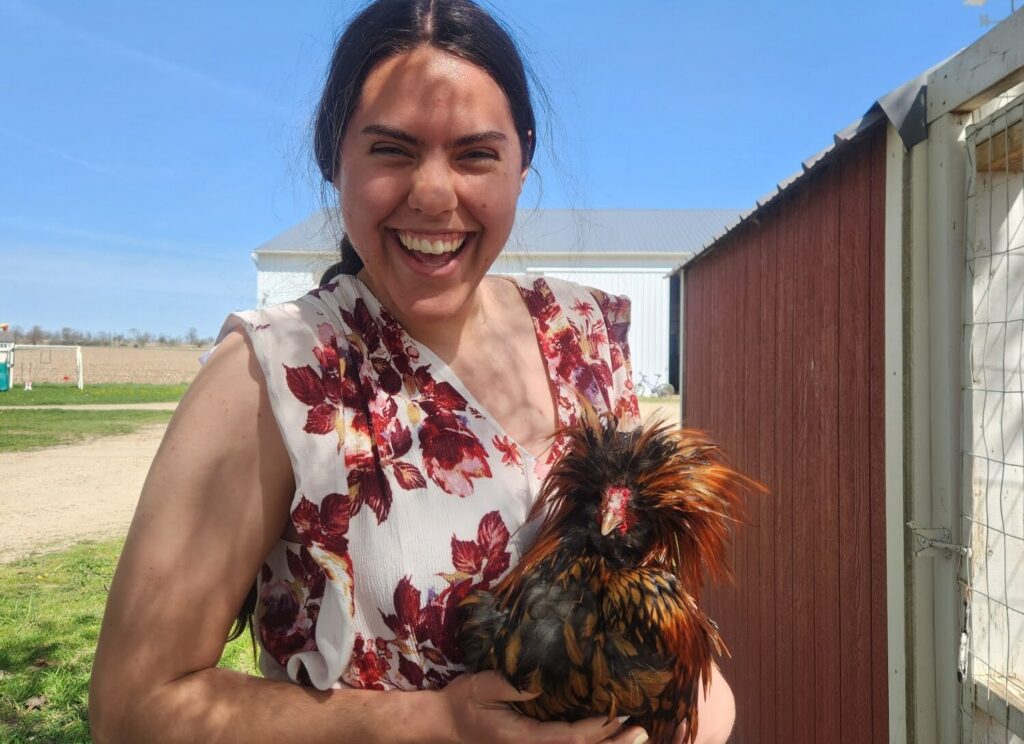
Feature Photo, My neighbor’s rooster, “Boofy”, and myself.