
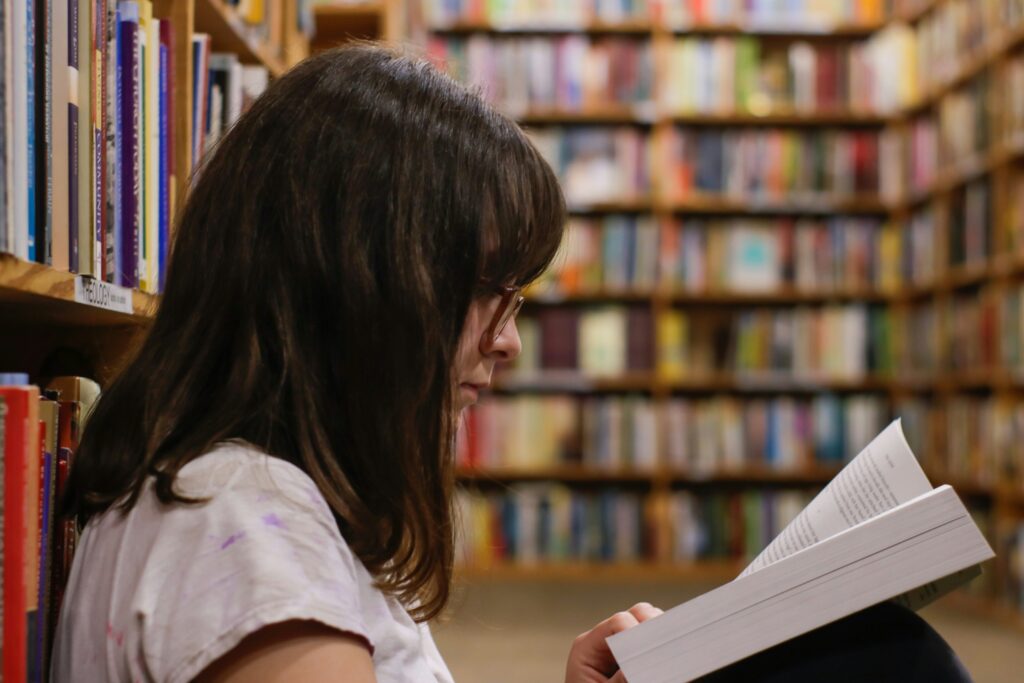
The Literacy Crisis on the Diag
Did college students really stop reading?
—By Liza Gavrilova
College students don’t read. At least that’s what some people say.
In October of last year, Rose Horowitch, a staff writer for The Atlantic, published an article claiming that elite college students have been struggling to engage with literature. Out of the 33 professors Horowitch interviewed, most recounted similar experiences of incoming freshmen unable to finish and comprehend assigned reading, especially long texts. Professors have had to simplify their reading lists, assigning short stories or passages rather than whole books. “One has to adjust to the times,” one told Horowitch.
This article is one of many raising alarms about the American ‘literacy crisis’. It seems like everyone has stopped reading books, opting to stick their nose in a phone instead. But on the other hand, reading is popular among young people. Women in their 20s dominate online book communities, and young celebrities flaunt their reading on social media. Books have even become fashion accessories, with brands like Miu Miu and Marc Jacobs using books to appeal to their consumer base.
So what is the truth? Despite less people reading, books are still prominent in the cultural zeitgeist. Have students actually stopped reading books, or is it more complex than just a lack of interest?
Defining the ‘literacy crisis’
Before talking about the literacy crisis, we need to define what it actually is. “The word ‘crisis’ really depends on what you mean when you talk about literacy,” says Elizabeth Birr Moje, dean of the Marsal Family School of Education and an expert in secondary and adolescent literacy, “How you define it will shape the extent to which there is or is not a crisis.”
For instance, some define the literacy crisis as students being functionally, if not completely, illiterate. But that is simply not true, as national test scores show that 68% of 12th graders, our nation’s incoming freshman class, can read and understand the major point of a piece of text. “If someone is reading at basic levels, they can not only read words, but they can actually identify the main idea of a passage,” says Moje. “If your definition of crisis is, they can’t read words, that is inaccurate. It is way overblown.”
So how do we define the college student literacy crisis? We can start with the simple assertion that college students have stopped reading books, as claimed by Horowitch. But the truth is more complicated than that.
Students are reading less
While Raven Cilley likes to read, she struggles to read consistently. “I would say [I read] probably between five and 10 hours per month,” says Cilley, an U-M astronomy major. “I tend to get really invested in a book and I will sit and I’ll read it for three or four hours straight. And then I don’t read again for like a couple weeks.”
The discussion of American literacy is muddled with misconceptions, but one fact is true—people are reading less than they used to. In a 2022 study, the National Endowment for the Arts reported that only 48.5% of US adults had read a book in the past twelve months, compared to 54.6 % in 2012. This is a 11% decrease in ten years.
Everyone, not just college students, is reading less books. But it’s not that interest is lacking, as shown by the importance of reading in current culture. So what is stopping people from just picking up a book?
No time to read
Between things like classes, extracurriculars, and jobs, it’s hard to find a moment to crack open a book. Justin Svarc, an U-M astronomy student, is a voracious reader during the summer. But by the time classes start, his weekly reading drops to 10 to 20 pages a week. “One of the biggest reasons I’m glad to be graduating soon is just so I can have more time for all the things that I like to do, reading especially,” says Svarc, “I notice how unable I am to do it during the school year.”
Lack of time is a very common barrier to reading. In a recent survey, NPR and Ipsos reported that 43% of respondents said that they don’t have enough time to read because of other life activities. “I think reading is up against the fact that we just don’t have enough time in the day,” Mallory Newall, vice president of public polling at Ipsos, told Andrew Limbong in a recent “All Things Considered” article.
When Americans are faced with a limited amount of time, they often choose to use it doing something else. “When asked what [survey respondents would] do with one extra hour of leisure time, the top of the list is spending time with family. Below that is a tied race between watching TV, reading and exercising,” writes Limbong
“Schoolwork takes up too much time,” says U-M chemistry major Sam Hopper. “Then I just don’t have energy to start a book.”
Too exhausted
But even if someone finds the time, that doesn’t mean they will have the energy to read a book. “It’s not necessarily that I don’t have time,” says Elliot Patterson, a recent graduate from the Ross School of Business. “There are definitely moments in the day when I’m like,’Oh, I could read right now’. But after work, cooking and making sure my house is clean, I feel exhausted and reading is a too-high-effort activity for me.”
So when up against a shortage of time and energy, many turn to other forms of entertainment that are not as taxing. “I’m so busy and then even when I’m not busy, I’m just exhausted and I just want to watch YouTube, ” says Cilley. “I don’t want to do something that actually requires brain power and thinking. So I don’t read.”
In fact, the ease of opening up Netflix or social media is what drives students from reading. “The biggest barrier for myself would be the availability of different forms of content, such as YouTube videos,” Svarc says, “I end up watching a lot of YouTube videos instead of reading.”
“It’s easier to just scroll on your phone and rot.” Cilley remarks.
Reading is still important
Despite struggling to find the time and energy to read, all four students value reading.
“Reading translates into so many different areas of your life. Just being able to read, like, proficiently is such a valuable skill. Because in the world we live in, we have to be able to read,” says Svarc
This desire to read more is also present in the general public. The NPR/Ipsos poll reports that about 71% of respondents want to become better readers, despite 43% saying that reading is low on their priority list. “We certainly want to be a reading nation,” Newall tells Limbong, “But we’re not necessarily prioritizing it as a leisure activity. I think instead, for many, especially for younger people, it’s certainly more aspirational.”
“It is really important for school and my job, like reading scientific articles.” says Cilley, “Reading for fun is also important to me and it’s something that I feel bad about not doing more often.”
Patterson values reading because it was his gateway to developing his passions. “Growing up, I read a ton and it was a really great way for me to use my imagination and explore new ideas,” says Patterson, “It inspired me to be creative. I’m into creative writing and I think if I didn’t read a lot growing up, I probably wouldn’t have that interest. And that would be really sad.“
Is there a literacy crisis?
So have college students stopped reading? Yes and no. While students are definitely reading less than before, it does not mean that they have stopped reading altogether. Despite the pressures put on them and the pull of access to easy entertainment online, students have still made time to read even just a little bit. If we want to address this crisis, we need to give students more time to rest, so they can catch up on the books they want to read.
The discussion around college students at elite universities not reading out of laziness and vanity is a red herring to bigger issues in our K-12 school system. While the majority of children can read at or above a basic level, that leaves about ⅓ of students that read below that. And many of those students are from our most vulnerable communities. “The ones who present some challenges with reading the main idea of a passage are well over-represented by poor, black, brown, and indigenous children,” says Moje. “The majority of those children are from poor areas, where the schools need better funding and better support structures to ensure that children in them are given every opportunity to learn to read basic or proficient levels.”
If one out of every three children cannot understand the main idea of a passage, they are not able to properly engage with our complex, ever-changing world. “We’re not teaching enough children to read deeply with complexity to solve our world’s problems, to listen to each other, to trade ideas, and understand and seek to understand,” says Moje. “There’s a crisis of equity. A crisis of opportunity and potentially a crisis of access.”
Feature Photo courtesy of Elliot Reyna on Unsplash