
The Rock Star Next Door
The life of a designer
—By Benjamin Cohen
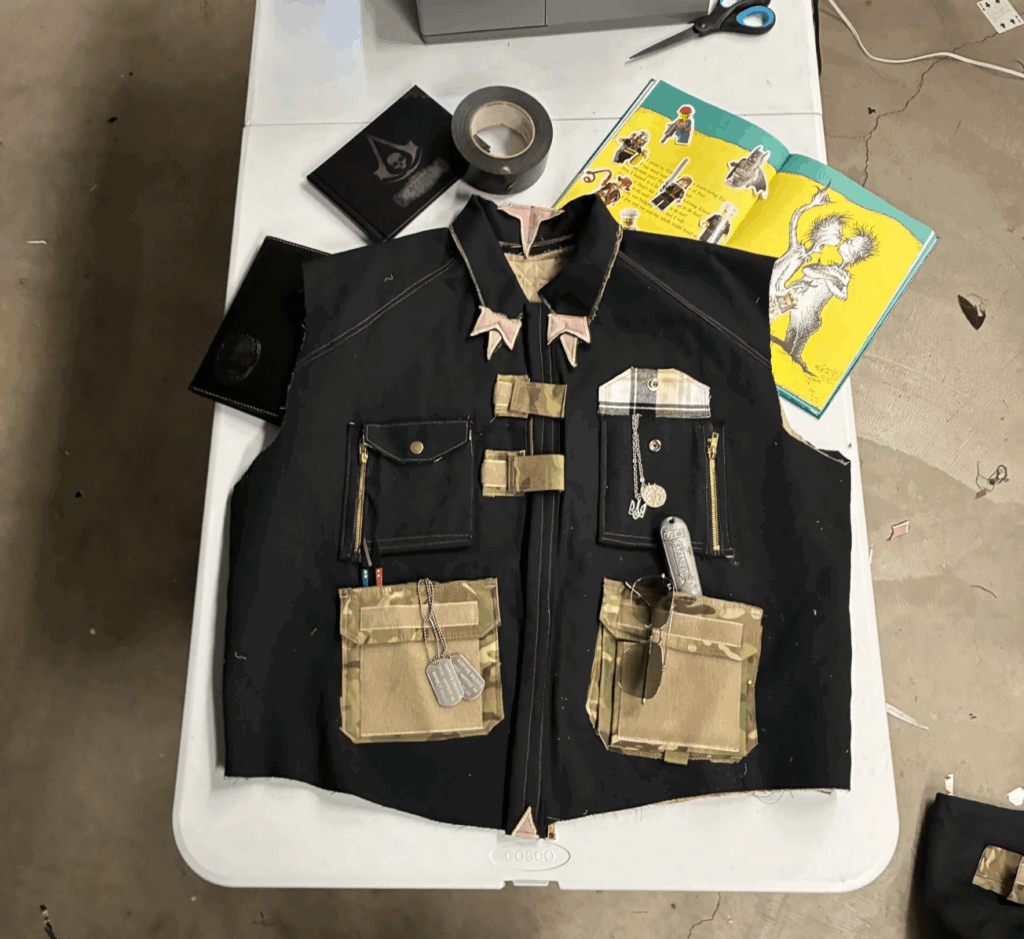
At two in the morning, with espresso shots still buzzing through his veins, Mathew Rose sits hunched over a sewing machine in Ann Arbor’s Stamps School of Art & Design. His denim scraps are scattered across the floor like confetti after a concert. He’s exhausted, but his mind refuses to rest. A half-finished vest meant for rapper DaBaby sits in his lap—born out of both improvisation and necessity. His machine breaks down mid-stitch, but instead of quitting, he tapes two needles together and improvises a technique on the fly: parallel double-needle stitching, now a signature of his work.
This is not just fashion. For Rose, it’s performance. Every garment is less about clothing and more about showmanship, about channeling the energy of the music and street culture he grew up in. “You can be a rock star in your own field,” he tells me. “My vehicle just happens to be clothing.”
Origins
Rose grew up in Los Angeles, immersed in a culture of street fashion. “I never had any intention to be a fashion designer,” he admits. “My creations are unapologetically myself. Everything I make is just a combination of my own taste.” Rose’s tastes were formed by skating with friends, listening to underground rap, and emulating the looks of his favorite artists. A$AP Rocky taught him to love Raf Simons; Lil Peep taught him about the emo-punk crossover. Music wasn’t just a soundtrack, it was a syllabus for his education in fashion. According to a survey by streetwear impact, 80% of consumer respondents indicated that hip-hop/rap music was a major influencer on streetwear, with 65% of consumers regarding musicians as the most credible figures in streetwear. These statistics back up Rose’s claim that fashion and music go hand in hand.
Rose didn’t learn fashion from a textbook. He learned by ripping apart his own pants, reattaching pockets, and stealing buttons from random objects. “It’s a blessing and a curse,” he laughs. “Everything I make is unique because I know it’s not done the ‘proper’ way. But that forces me to figure it out on the go.” The do it yourself approach means that experimentation is vital to creating lasting innovation.
Building a jacket for Dababy
When Rose learned DaBaby was performing on Michigan’s campus, he reached out to RushLink: the company in charge of handling the event. RushLink agreed to let Rose create a vest for Dababy, giving Rose only five days to create something to present. His resources were limited, but his instinct for improvisation guided him.“I first wanted to make some sort of jacket,” he recalls. “But I didn’t have enough fabric for sleeves. So I turned it into a vest. ”This pivot reflects Rose’s larger design philosophy: experimentation born from constraint. Rather than chase perfection, he embraces failure and adapts. “Every mistake tells a story,” he says. “If I miss a stitch, I rip it out. That rip is invisible to everyone else, but I know it’s there. And that in itself becomes part of the garment’s story.”
The result of obsessive and determined work was a black denim vest with bold yellow stitching, nodding subtly to University of Michigan colors. The final product embodied Rose’s belief that speed can be an artistic virtue. “As a creative, if you overanalyze yourself, you’ll never finish,” he explains. “I like moving fast. That pressure teaches me to do things faster and smarter.”
Similarities between rockstars and designers
Rose insists that the influence that designers have on people today is very similar to those of the rock gods of the past. Influenced by Off-White’s founder, Virgil Abloh, Rose recalls how the fashion titan was known for being in two, even three cities during the same calendar day, and sometimes these cities were on different continents. To Rose, fans obsess over material brands, just as they obsessed over guitar riffs. In fact, designers headline Met Gala carpets, and have their names broadcast and marketed like band posters. It’s a lifestyle that demands obsession. Rose design processes embody this lifestyle. He describes sneaking into studio spaces at midnight, working twelve-hour marathons, and letting his ideas consume him until they’re released. There’s no average fashion designer who makes it big. You have to put in those 10, 12, 14-hour days.”For Rose, this devotion isn’t sacrifice, it’s fuel. “Me sitting here talking to you is just as much part of designing as being at the sewing machine,” he adds. “It’s a mindset.”
Balancing student and designer life
Rose, after all, is still a full time student at the University of Michigan. The question becomes where to find the time to manage school work with the pressures of design deadlines and creating garments for artists. Rose’s approach is simple and unique. What’s the need to separate his academic and creative lives? “I’ll write essays about fashion. I’ll ask professors if I can make something instead of doing a paper,” he explains. “Combining those two lives makes both more meaningful.” This intensity and commitment to creative excellence can be staggering. A typical crunch cycle might involve sleepless nights and stitching until dawn. For Rose, the process is fun and rewarding. “I love knowing and feeling that I care about something so much I’ll work 14 hours straight,” he says. “Not everyone gets to experience that kind of passion.”
Dreams beyond Ann Arbor
When asked about his ultimate dream project, Rose doesn’t hesitate; he wants his fashion showcased mid-concert, blurring the line between performance and runway. “There was this one VFiles show where Cardi B performed in the middle of it,” he recalls. “That’s always been a dream of mine, to have someone perform while wearing my clothes. It almost immortalizes the garment.” Pressed to name an artist he would most want to design for, he smiles: “If I could dress Skepta for a concert, that would be everything. It’s that perfect connection between music and fashion.”
Despite his successes and large portfolio of impressive garments for former Michigan football players, rappers and influencers, Rose is rarely satisfied with his own work. He speaks of garments with affection but also with critique, seeing the flaws invisible to outsiders.“It’s almost immature to think something is perfect,” he reflects. “If I had more time, more resources, I know I could make something more mesmerizing, but that itch is what keeps me going.”
Feature photo, Matthew Rose’s work; Photo Credit, Ben Cohen