
Diet Culture and Health Myths
How social media is reshaping student wellness
—By Haley Tolan
Every time Zoe Fauble opens TikTok, the algorithm knows exactly what to show her. Quick-fix fitness routines. Macro-counting guides. Before-and-after transformations. The accessibility draws her in: health information instantly at her fingertips, clear and digestible in less than a minute. But after trying a 30-day ab challenge and cutting out foods she saw labeled as “unhealthy,” Fauble noticed something: the trends that look perfect on screen rarely survive contact with real life. Between classes, work, and a two-hour commute, she couldn’t maintain what influencers made look effortless. She started feeling anxious about not doing enough, guilty about eating fast food, and pressured to look a certain way based on transformation posts she’d seen online.
Fauble’s experience isn’t unique. Across college campuses, students are caught in the crossfire of diet culture and health mythology propagated through social media platforms, where self-appointed wellness gurus speak with equal authority as credentialed experts. The result is a generation of students increasingly anxious about their bodies, confused about nutrition, and susceptible to misinformation that can spiral into disordered eating patterns.
The algorithm’s echo chamber
Julie Stocks, a registered dietitian at the University of Michigan Health System, encounters the fallout daily. “I’d say every day, people are checking me on ChatGPT or telling me what they saw online,” she said in our interview. “Without understanding the whole history or experience from a dietitian’s point of view, it’s hard to know what someone actually needs.”
The problem isn’t just misinformation; it’s the sheer volume and persuasiveness of it. Social media algorithms are engineered to show users more of what keeps them engaged, which means health content tends to cluster around the sensational, the extreme, and the restrictive. Fauble noticed this pattern herself: “The algorithm can create an echo chamber where you just see the same type of advice over and over, so you start to believe it even if it’s not accurate.”
For students already anxious about their health and appearance, one trending video about protein macros thus leads to dozens more. One before-and-after transformation becomes a feed full of them. The constant exposure normalizes an intensity of focus on diet and body that diverges sharply from evidence-based nutrition.
The carb myth that won’t die
Walk through any college dining hall and you’ll hear the refrain that carbs are the enemy. This misconception, according to Stocks, frustrates her most. “If I could wave a wand and fix something,” she said, “it would be the carb thing.”
The carb-phobia trend, which exploded after the Atkins Diet emerged onto the scene in the 1970s, persists despite decades of evidence to the contrary. Yet when Stocks looks at global diets from Asia, India, Italy, and Mediterranean regions, she sees people eating carbohydrates regularly and maintaining healthy weights. She emphasizes that glucose is necessary for the human body. “You need those carbohydrates. They’re good for you throughout the day,” she said.
On platforms like TikTok and Instagram, this nuance gets lost. Instead, creators tout low-carb diets as universal solutions, and students internalize the message that carbs are something to eliminate or drastically reduce. The result is a generation of students afraid of one of the most basic food groups, often without understanding what carbohydrates actually do.
The protein obsession
If carbs are demonized, protein is deified. The fitness industry’s relentless focus on protein has created a cultural belief that more protein always equals better health and faster results. Yet science tells a different story.
According to Stocks, the recommended protein intake for non-athletes is 0.8 to 2.0 grams per kilogram of body weight. For the average female college student (around 60-70 kg), this translates to roughly 48 to 140 grams daily, and for males (around 70-80 kg), approximately 56 to 160 grams. True athletes (those working out two to three hours daily or on competitive teams) might aim for the higher end of this range or slightly beyond. Yet fitness creators routinely recommend amounts well beyond these guidelines, often alongside protein shakes and supplements.
“You can get too much protein,” Stocks explained. “When you overeat it through protein drinks, it can delaminate, come through the kidneys, pull out water, pull out calcium. You’re kind of defeating the purpose.”
More insidious than physical effects, however, is the mental toll. Stocks has witnessed patients develop severe anxiety around hitting specific macro targets. “It can lead down a rabbit hole of being very focused and detailed, counting and counting and counting and trying to get it right,” she said. “When it takes up 80% of your mental space and you can’t eat without thinking about it, that’s putting a whole lot of pressure in an area that we can ease the pressure from.”
When wellness language masks diet culture
One of the trickiest aspects of modern diet culture is how it hides behind the language of wellness. Videos labeled “guilt-free,” “clean,” or “macro-friendly” often promote the same restrictive mentality as traditional diets, just with better branding.
Stocks identifies several red flags. When recipes eliminate entire food groups, focus narrowly on specific macronutrients, or make claims about foods’ effects on the body, diet culture is usually lurking beneath. “Flash-frozen vegetables are not inherently unhealthy,” she noted, citing an example of how the term “processed” has been weaponized to create unnecessary anxiety. “They’re just flash frozen out of a field.”
The language matters too. When creators use words like “clean,” “detox,” “good,” and “bad,” they’re applying moral judgment to food, a hallmark of diet culture. Fauble noticed this distinction: “I’ve definitely seen contradictory advice about things like whether carbs are good or bad, or whether you need to work out every single day to be healthy.” But what she’s really describing is the difference between flexible, sustainable nutrition guidance and rigid, morally laden diet rules disguised as wellness advice.
There are creators, however, who are working on “getting it right”. Creators like Abbey Sharp of Abbey’s Kitchen, Liam Layton, and Liv Carbonero all focus on balance and evidence-based information rather than restriction. They discuss food in context, acknowledge individual needs, and promote sustainable habits rather than quick fixes.
Abbey Sharp, a registered dietitian nutritionist, is known for her detailed breakdowns of viral diets and trending nutrition claims, methodically debunking misinformation while explaining the science behind why certain approaches fail long-term. She prioritizes nuance over simplicity, often spending multiple videos on a single topic to ensure followers understand the full picture rather than soundbites. On her blog, she discusses how “in the wake of wellness culture, the sexy D word ‘detox’ has effectively replaced the bad D word – ‘diet’”.
The credentialing gap
Not all nutrition advice online is created equal, yet most students don’t know how to distinguish between credible sources and well-packaged marketing. A critical distinction exists between registered dietitians (RDs) and self-proclaimed “nutritionists.” Registered dietitians have credentials, belong to the Academy of Nutrition and Dietetics, pursue continuing education, and are medical professionals. Most people sharing nutrition advice on social media have no such qualifications.
Additional creators on Instagram like Liam Layton (@theplantslant) and Liv Carbonero (@livcarbonero) demonstrate varying levels of credibility in the nutrition space. Layton, a graduate student in nutrition at The Ohio State University, brings academic training and evidence-based plant-based nutrition expertise to his content. He debunks myths while showing that healthy eating can be visually appealing and genuinely enjoyable, moving away from the “clean eating” aesthetic that breeds restriction and toward food that’s both nourishing and pleasurable.
Carbonero, while promoting positive messages about intuitive eating and sustainable habits without obsessive tracking, lacks formal nutrition credentials. She bridges the gap between fitness and food freedom, but her advice, like that of many influencers, isn’t backed by the same educational foundation or professional accountability that credentialed nutrition professionals must maintain. This difference matters: even well-intentioned advice can mislead when it’s not grounded in nutritional science and clinical training.
When Stocks advises students on evaluating online nutrition advice, she recommends checking for credentials and applying what she calls “the smell test.” “If it almost sounds like a sales pitch, if they’re making promises or strong suggestions that this is what works and everybody else is wrong, that kind of thing,” she said, those are warning signs.
Yet Fauble admitted to a pattern many students share: “I’ll admit, if something sounds reasonable and comes from someone with a big following, I’ll probably believe it without really checking.” She also noted relying on peer influence: “My friends probably influence me more than I’d like to admit. If a friend is trying something and they’re excited about it, I’m way more likely to want to try it too.”
The mental health cost
Beyond confusion, the persistent focus on diet and body transformation is taking a psychological toll. Fauble described feeling “anxious and inadequate” after scrolling through health content, comparing herself to people who “seem to have it all figured out.” She felt pressured to exercise five days a week despite already being busy, guilty for eating fast food, and ashamed for not meeting standards she’d internalized from social media.
These feelings aren’t character flaws or signs of weakness. They’re predictable responses to an environment designed to make people feel inadequate so they’ll consume more content and products. Stocks emphasizes this point: “There’s no magical cure for anyone’s weight, nor should there be because it has a moral placement on it, a judgment on it.”
For students developing disordered eating patterns influenced by health content, finding professional support is crucial. Stocks recommends starting with a primary care doctor, who can connect students with a registered dietitian or medical social worker. Resources like the Academy of Nutrition and Dietetics can help identify qualified professionals in the community. Mental health therapists, too, often know registered dietitians experienced in treating disordered eating.
What gets lost
When people get nutrition advice from social media instead of medical professionals, Stocks says, they lose several things: expertise, the ability to access a comprehensive knowledge base, and most critically, individualized care. “Social media is a one-way conversation. It comes at you,” she explained. “When you have a professional, it needs to be a two-way conversation because it has to fit the person.”
Registered dietitians are trained in motivational interviewing, a skill set that helps people identify their own priorities and chart sustainable paths toward health. An influencer saying “you should do A, B, and C” is fundamentally different from a professional asking, “What matters to you? What are your priorities? What would work for your life?”
The gap between these two approaches explains why a 30-day ab challenge fails for Fauble but individualized guidance from a professional could succeed.
Food as experience, not numbers
Stocks’s own background shaped her approach to nutrition. Growing up in an Italian family, she learned to view food culturally and experientially rather than as something to count and control. “We would sit down to a Sunday dinner. Different foods come out. People are interacting, coming and going, talking to each other,” she recalled. “Don’t reduce it to a number. That’s not what food’s about. Not for humans.”
This perspective challenges one of social media’s fundamental flaws: its reduction of eating to quantifiable metrics. Macros, calories, protein grams, workout minutes. These numbers dominate health platforms. But humans eat for reasons far beyond fuel: emotional bonding, pleasure, socialization, celebration, comfort, and connection. “Food in and of itself, from birth, right? Human babies eat for emotional bonding, pleasure, socialization, and food,” Stocks emphasized. “That imprints on the human brain. We eat for a variety of reasons.”
The path forward
So what should students know about nutrition that contradicts what they’re seeing online? According to Stocks, carbohydrates are essential and not the enemy. Protein needs are lower than most fitness creators claim, and protein shakes aren’t necessary. Health isn’t determined solely by weight; sleep quality, energy levels, mental health, and mood matter too. Most importantly, sustainable habits that make you feel good matter more than perfection.
Fauble’s suggestion for change is practical: she wants clearer verification of people’s credentials, better labeling of sponsored content versus genuine advice, and smarter algorithms that don’t push extreme or unhealthy comparisons. Perhaps most compellingly, she advocates for media literacy education in schools. “I wish schools had taught me more about how to actually evaluate sources and question things I see online,” she said. “I think a lot of students just believe what we see online without really questioning it, and that could be harmful.”
This generation of students deserves better: platforms that reward accuracy over sensationalism, influencers who prioritize health over sales, and algorithms engineered to inform rather than exploit. Until then, the antidote is education, critical thinking, and a return to what Stocks emphasizes: viewing food as the complex, cultural, joyful part of being human that it actually is.
The transformation that matters isn’t the one plastered across TikTok. It’s the shift from anxiety-driven restriction to sustainable, evidence-based wellness, and from comparing ourselves to influencers to connecting with professionals, communities, and the simple pleasure of sharing a meal.
“Food is meant to fuel us and connect us,” says Fauble. “It’s time we reclaim it from the feeds and give it back to ourselves.”
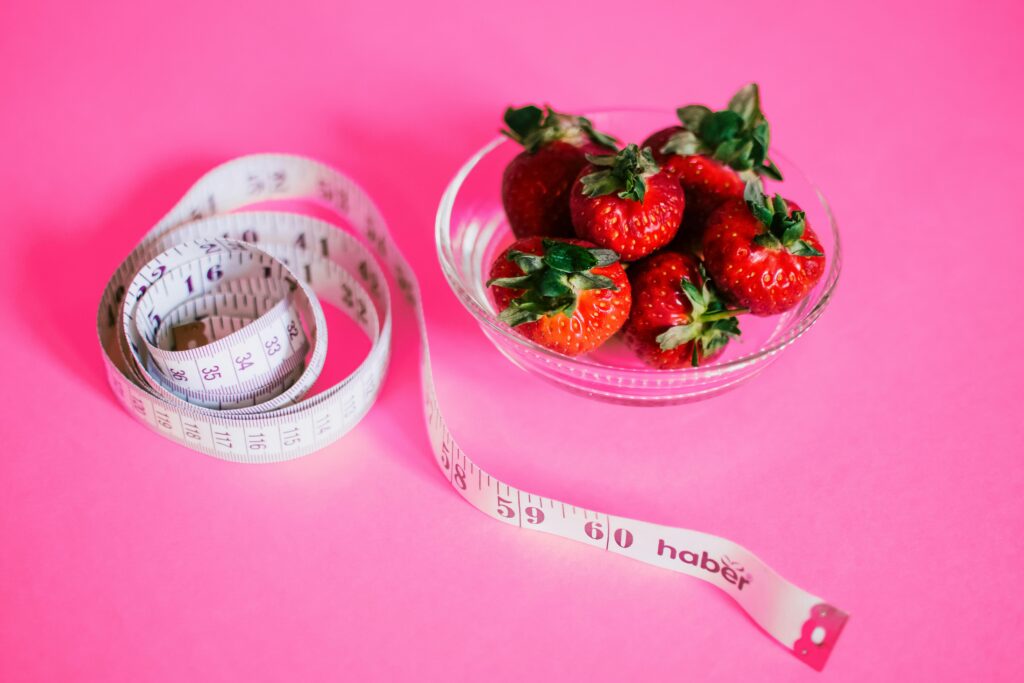
Featured image: A measuring tape next to a bowl of strawberries; Photo by Lisa on pexels.com