
Breaking Barriers
How Dr. Michelle Aebersold is revolutionizing healthcare education through AI and Virtual Reality
—By Haley Tolan
“We don’t know how to talk to each other.” These words from Dr. Michelle Aebersold are not just frustrating; they are dangerous.
Miscommunication is one of the leading causes of medical errors in healthcare, contributing to 70% of sentinel events tracked by the Joint Commission, an organization that accredits hospitals and healthcare facilities across the United States. These sentinel events represent the most serious incidents in healthcare: unexpected deaths, major permanent injuries, or events that could have led to such outcomes.
Yet most medical training still focuses more on procedures than conversations. Through her pioneering work with artificial intelligence (AI) and extended reality (XR), Dr. Aebersold is helping to change that, giving students and healthcare providers a safe space to practice empathy, teamwork, and difficult conversations that can improve trust and ultimately save lives.
The vision behind the technology
As a nursing educator, Dr. Aebersold has spent years balancing the limitations of traditional healthcare education. Students might excel at memorizing medical procedures and information, but when it comes to communicating with patients or colleagues during high-stress situations, many struggle. Her solution combines cutting-edge technology with fundamental human needs: AI-powered avatars that create realistic scenarios where learners can practice not just what to do, but how to say it.
“If learner A goes through scenario one and two and scores really well….why not make it more challenging for the rest of those scenarios?” Dr. Aebersold explains. This individualized approach represents a fundamental shift from one-size-fits-all education.
The AI algorithms can create scenarios that adapt to each learner’s knowledge, decision-making skills, and communication abilities. A student who masters the earlier and easier scenarios faces increasingly complex challenges, while those who struggle receive additional support. With AI integration, these students will be able to receive customized feedback and acknowledge how they communicate, as well as how they can improve.
Beyond traditional simulation
The technology extends far beyond simple simulation. In an upcoming project, Aebersold is developing AI avatars that can engage in natural conversations with students. Rather than programming every possible response, she provides the AI with a patient’s backstory. Unlike traditional model patients, these AI avatars require less time to create, which allows for more time spent using this tool.
“As an educator, it’s really a great way for me to be able to create robust scenarios and then not have to think of every little detail,” she explains. “The AI can then create ages for grandchildren or names and things like that. Some of the details just don’t matter; it doesn’t matter if he’s got six boy grandchildren or six girls.”
This approach allows students to have organic conversations with virtual patients, practicing the communication skills that can make the difference between a positive and negative healthcare experience. The scenarios focus intensively on communication rather than technical procedures, helping students learn how to talk to a patient. The AI can provide real-time feedback on students’ communication to help learners understand which approaches work best in different situations.
Addressing the workforce crisis
Dr. Aebersold’s work comes at a critical time for healthcare. The industry faces severe workforce shortages, particularly in nursing, with the biggest bottlenecks being faculty shortages and limited clinical placement opportunities. According to the National Council of State Boards of Nursing, in Michigan, undergraduate nursing students can substitute up to 50% of their required clinical hours with simulation experiences. XR technology makes it possible to scale these simulations significantly.
“Look at how many students we ran, 80 to 85 students through an eight-hour day in simulation, and they all got credit for that towards their clinical hours,” Dr. Aebersold notes. “I can’t run that many students through mannequin simulation.” This scalability is particularly crucial for specialties like obstetrics and pediatrics, where finding appropriate clinical placements is increasingly difficult.
According to the American Association of Colleges of Nursing, nursing schools turned away 91,938 qualified applicants from baccalaureate and graduate nursing programs in 2022, primarily due to insufficient faculty and clinical sites. Dr. Aebersold’s XR approach offers a potential solution to both constraints.
The technology also helps students transition from the classroom to real-world practice. “Our students walked out of there; they can do a good SBAR (Situation, Background, Assessment, Recommendation) communication,” Aebersold says, referring to the standard healthcare communication framework. “So that’s one less thing that they have to worry about trying to learn in their orientation.” However, questions remain about whether AI avatars can authentically represent the diverse experiences of real patients, particularly regarding how race, class, gender, and social determinants of health influence patient interactions and communication styles.
Overcoming resistance
Despite the promise of these technologies, Dr. Aebersold encounters resistance rooted in misconceptions. Some fear that AI will replace nurses entirely, rather than supporting them. “What I see is this becoming more of an assistant or a support to nursing and healthcare workers, not a replacement,” she expressed.
Similarly, concerns about VR technology, specifically “cyber sickness” and the belief that headsets inevitably cause migraines, often proved to be overstated. While individual sensitivities exist and require accommodation, many concerns stem from preconceived notions rather than experience.
The biggest hurdle to widespread adoption, however, may be cost “Students are shelling out $200 a student for a license. Do you want to pay $200 for access to do five scenarios? Probably not,” Dr. Aebersold observes. Unlike simulation mannequins that represent a one-time capital cost, XR programs often require expensive ongoing subscriptions.
The stakes are life and death
What drives Dr. Aebersold’s work is the stark reality of medical errors. Approximately 250,000 patients die annually from preventable medical errors, according to the Joint Commission’s Sentinel Event Data 2024 Annual Review. “We use a different language. Nurses talk differently than physicians, who talk differently than dental. We all grow up in a different culture,” Dr. Aebersold comments.
This communication crisis extends beyond provider-to-provider interactions. Research published in the Journal of Patient Safety suggests that medical errors may be the third leading cause of death in the United States, behind only heart disease and cancer. Many of these errors stem from breakdowns in communication during handoffs, unclear instructions, or misunderstood patient concerns.
AI and XR can create multi-participant experiences where students practice collaborating across these cultural divides, where the virtual can play these roles in an authentic manner.
Looking ahead
What excites Dr. Aebersold most about the future is the potential for truly natural language interaction between students and AI-powered patients. Early attempts using voice recognition technology proved frustrating, but advances in natural language processing now make more sophisticated conversations possible.
The ultimate goal extends beyond individual skill-building to systemic change. By creating safe spaces for healthcare providers to practice difficult conversations and build communication skills, Dr. Aebersold’s work has the potential to save lives.
The human element
This technology aims to serve deeply human purposes. The AI avatars and virtual reality environments are not meant to replace human connection but to enhance it, giving healthcare providers the skills and confidence they need to communicate more effectively with real patients and colleagues.
As healthcare continues to evolve, the integration of AI and XR into medical education represents more than just technological advancement; it’s a recognition that the most sophisticated medical knowledge means little without the ability to communicate it effectively. “The goal is not to replace human connection,” Aebersold emphasizes, “but to give healthcare providers the skills they need to make those connections meaningful.”
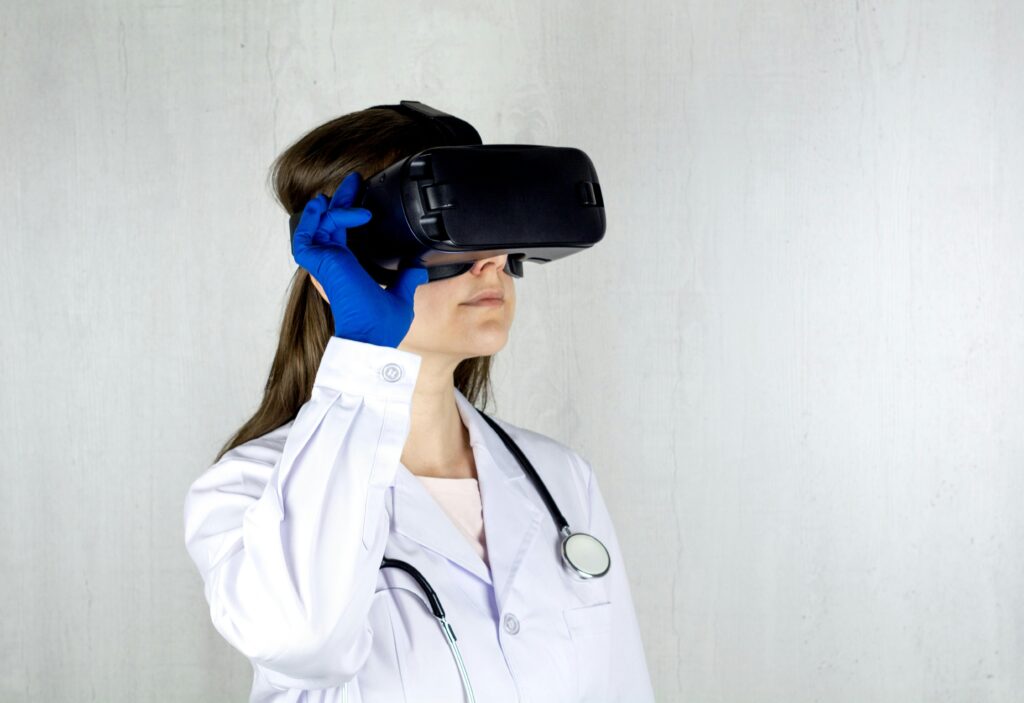
Featured image: A woman in a white coat with a stethoscope around her neck wearing a black virtual reality headset; Photo by Michael Berdyugin on pexels.com