
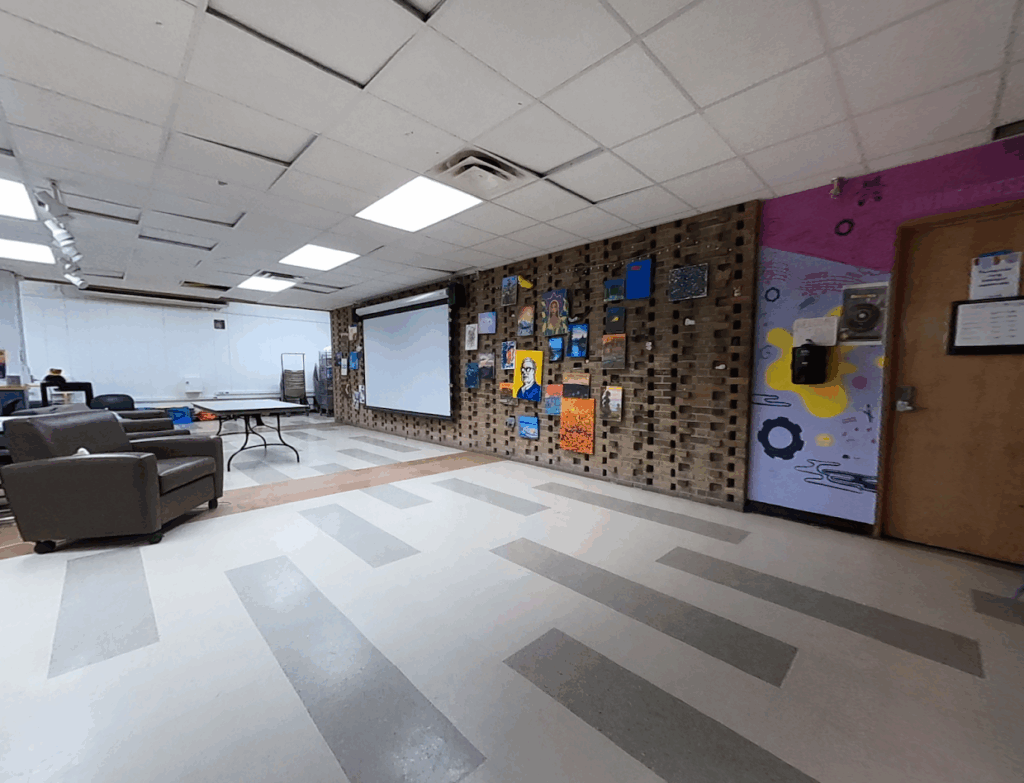
Putting the Heart Back Into Engineering
Living ArtsEngine blends creativity and first-year living
—By Charleson Shuart
I was sitting in my room on an unusually warm September morning, groggily staring at my computer preparing for another day of tedium. The hours ticked by as I went through my day, haphazardly writing notes on my notepad whilst I listened to another lecture on the importance of good work ethic. That’s when I had a realization: I wanted to make something—anything—beyond my own scope of understanding. A snowman, a paper crane, a silly doodle on a sticky-note as I was crunched for a terrible deadline—a reminder that I still had the time to breathe… A breath that was slowly being stifled through outside influence—through the division and segmentation of disciplines.
Outside pressures in society have created this general sentiment that you must be either in Liberal Arts or STEM, lest you ruin your own career by underspecializing into your job, a phenomenon that is usually referred to as “spreading yourself too thin” and is often considered a waste of your valuable time. As my interviewee Rachel Oti, Program Director of Living ArtsEngine, put it; we “forget to be curious about what’s outside,” and that leads to a lacking degree of curiosity and diversity in our society.
There is a general divide between the arts and the sciences at the University of Michigan– Living ArtsEngine is a direct answer to this issue of interdisciplinary collaboration as a novel First-Year living experience. It is an arm of the Arts Engine program and is sponsored by all five North Campus Colleges: A. Alfred Taubman College of Architecture + Urban Planning; Penny W. Stamps School of Art & Design; School of Music, Theatre & Dance; College of Engineering; and School of Information. The goal of the program is to introduce students to the college lifestyle through living in Bursley—a Residential Dormitory on North Campus—to introduce collaborative and creative thinking, through interdisciplinary cooperation and integration.
From humble beginnings
Oti has a Bachelors of Education from Aquinas College and a Masters of Art Administration from Eastern Michigan University, which lends to her style of interaction with students. As Program Director she is often preparing for the next step of each year; community programming, creation of marketing materials, communications with current students and past alumni, and many other things on the day to day. Her experience reflects some of this experiential learning model; she originally worked with the Arts at Michigan program—now part of Arts Initiative—where she would write for art competitions, opportunities, campus newsletters, and more. The goal was to grab the attention of students and put the arts back in their hands, and it worked—but after 6 and a half years, Oti wanted something new, something different.
That difference came in the form of an opportunity to work as the Assistant Director and Program Manager of Living ArtsEngine—from there she was thrown into the full position of Program Director in a shuffling of roles. By Oti’s own admission, it was not planned, but just simply “happened that way.”
When she had first heard about the concept of an interdisciplinary living community, she wasn’t sure what to think. The idea of bridging the gap between the Arts and STEM through student programming—workshops, managing students living within Bursley in the Van Hoosen and Rotvig Halls, and working with formal class learning—was a far cry from her general experience. Oti said that she “hadn’t participated directly, but was a consistent advocate” for these programs. As Oti grew into her role, her beliefs that this program was necessary were reinforced; a form of “practice for the real world.” Living ArtsEngine creates challenging scenarios to elicit different lines of thinking, much like the expectations placed on the workforce of today.
The day to day experience
As greater emphasis is placed on these first-year programs, there is a growing concern on maintaining and promoting the success of students in STEM. First-Year College Experiences have been utilized and credited as a tool to bridge that gap, as indicated by a study in Innovative Higher Education. These first-year programs increase retention and academic success of STEM students, as well as being a potential catalyst to “strengthen relationships between faculty, students, and staff.”
Oti finds that Living ArtsEngine brings in a “specific crowd” of students; those who are willing to experiment and provide novel perspectives. Oti likens it to a table of sorts where everyone has something of value to offer. By ignoring other perspectives, we might miss being on the “forefront of really impactful solutions,” she said. This vision has been slowly culminating in her adapted variation of Living ArtsEngine; something that is clumsy and a bit rough around the edges, but oddly charming and continuously working towards more scrappy and novel solutions.
Student sharing: something special
B is a Senior studying Robotics, and has served as both a mentee and peer mentor within Living ArtsEngine. Students are batched into groups of 4-5 people, and are assigned a Peer-Mentor; B stated that Peer-Mentors are a returning student from the prior year who is there to guide, befriend, and acclimate the student to their first year in college. For the first semester, mentees take UARTS 150, a class taught by several professors in multiple departments with analysis of techniques and “writing and creative solutions” being paramount. “We had workshops, I did one where you would play a videogame, but with the specific lens of trying to pay attention to the soundscape—I played Pikmin 3—I got to notice a lot more detail on how it’s conveying the passage of time through sound effects and the music.”
Students also participate in workshops and community meetings where there are a variety of team building activities and creative endeavors: “someone makes a PowerPoint about whatever—painting miniatures, sewing, programming an Arduino, how to make a PowerPoint—and just teaches in a low-stakes environment,” B stated. The sky is the limit for the workshop’s subject and discipline, but it is there primarily to spread knowledge about something you are passionate about.
In the second semester students work in groups on a semester-long project through UARTS 175. Their work is shown at the Duderstadt Library Gallery—the LAE Symposium. Students are given three theme words; B’s were “Inflation, Generation, and Facade,” and attempt to create a project related to their interpretation of those words with Peer Mentors assisting and mediating. “It helps to build community team skills, and is fun overall,” B said, noting how it was “amazing to see what a bunch of interdisciplinary people do, when they have no limit.”
In addition to the more official activities, there are a lot of impromptu and unplanned events where students will talk for hours at a time, head out as a group and go somewhere interesting. Students also hold a tea time event where they get cookies and tea every Saturday evening and “discuss things that [they] might’ve not discussed at all.” B came there for the community, even if it’s a “hard thing to describe” by his own admission; he loved the people and the experience, and “being able to be in touch with the creative side” of himself.
Building budget
As with any program, Oti has to be very mindful of the budget and opportunities given to students. Balancing these aspects can lead to feelings of lacking facilitation, something that reflects on students. When asked about budgetary constraints and the impact of programs within the University of Michigan, Oti said that it was not adequate. Looking at the program and its novelty, she said it feels like LAE is stagnating. She wishes to “gain more collaboration amongst the schools and colleges with more interdisciplinary courses” akin to UARTS 150 and 175 that give “incredibly valuable skills to students as they go through their college and adult life.”
Though Living ArtsEngine would like to operate on a wider scale, they only have as much ability as the University gives them. There are growing concerns as the current administration puts pressure on programs that promote Diversity, Equity, and Inclusion as the article ”University of Michigan closes its DEI office, ending multi-million dollar investment into diversity” from Politico states. Despite this, Oti is confident that Living ArtsEngine will be able to weather the storm, and that more colleges and U of M should take note of potential implications.
Moving forward
Though this optimism on the future of Living ArtsEngine shines bright, there are concerns that the division between disciplines will result in less adequate thinkers and workers. Allison Marsh’s article “Why Engineers Still Need the Humanities” from IEEE Spectrum is a testament to this sentiment. Marsh argues the importance of maintaining a deeper connection between the Liberal Arts and STEM, looking at it as a foundational piece of modern sciences, and ruminating on the “training, conduct, and professional identity, [one] may realize that [they] owe much of this to the humanities.”
As we continue to posit new perspectives, one might question whether this divide is not the result of just one side, but both; visual arts and prospective arts are not significantly different versus STEM. Living ArtsEngine encourages this connection whilst attempting to mitigate the gap for either side; a personal touchpoint for students, as B said.
Living ArtsEngine and Rachel Oti still stand as a testament for this ideology of recognizing the value of these roots, but at the end of the day, we don’t know what the future will bring; whether it be a STEM dominated world, where humanities fall into the obscura, or a humanities-driven society, where STEM is in the background. Though this is not necessarily concrete, Oti is still confident in the persistence of the field and of the program itself. “Living ArtsEngine gives opportunities for students to create things, that never would’ve been possible, just on their own or just in their discipline; I just set it all up… I get to watch it happen and something wonderful grows.”
Addendum: As of publication, Living ArtsEngine and ArtsEngine are potentially being sunset in May of 2026. Current reasoning is not known, but if you’d like to support them and their mission, this petition is one way to do so. B stated that “this program has changed me for the better, and I’m sad to see it go.” Similar sentiments were expressed from Garrett.
Feature Photo: Creative Suite, Bursley Hall, by Charleson Shuart