
Code and Cello at U-M
Balancing music and computer science as a senior student
—By James Tian
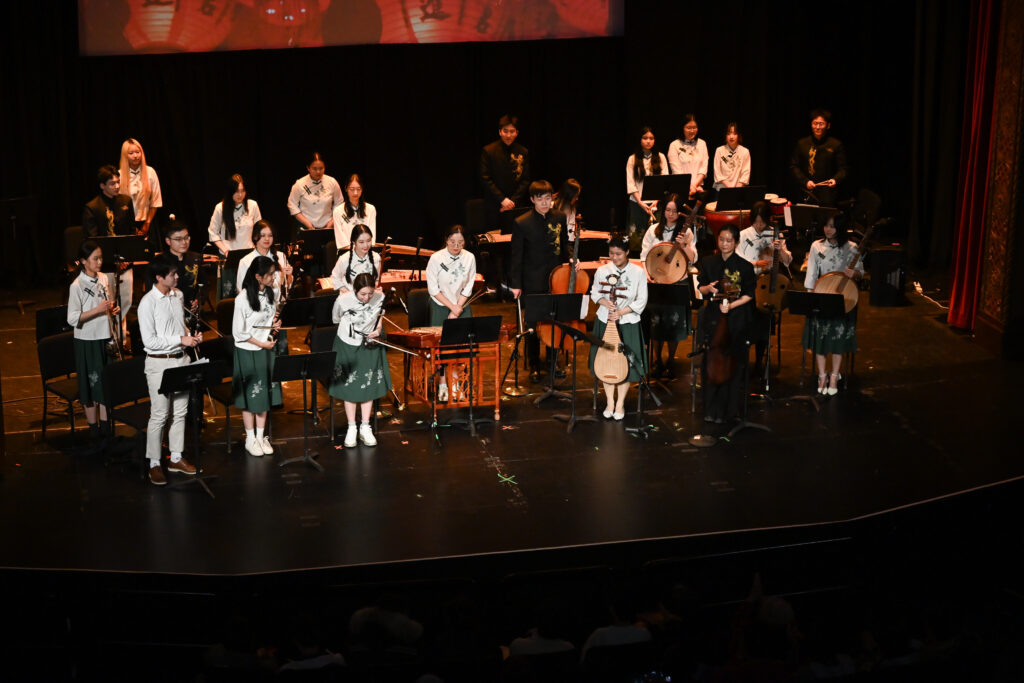
On a chilly March evening, the recital hall of the University of Michigan School of Music was immersed in the gentle harmonies of the pipa, erhu, and cello weaving together into a cascading wave of sounds. Nearly two hundred people packed the seats, curious to see what the student-run Qingyun Chinese Orchestra had prepared. On stage, Peter Ren, a computer science senior, leaned into his cello, the bow gliding softly across the strings as he set the tone for the ensemble. For Ren, the motivation goes beyond performance—he enjoys playing Chinese traditional music with the ensemble, seeing it as a way to share the distinct sounds and styles with a broader campus community, while also keeping a piece of his cultural identity alive.
“For me, playing music is like a moment of relaxation after studying,” he said. For someone juggling programming projects, graduate school applications, and job interviews, this might sound like a luxury. However, Ren believes that music is less a distraction than a survival strategy—a way to stay balanced in a year when STEM students often feel stretched to the breaking point.
A semester under pressure
The pressure is real. Senior year in computer science is not designed for free time. Between dense project deadlines, graduate school applications, and the relentless cycle of job interviews, every hour can feel spoken for. And Ren isn’t alone in that feeling. According to the American College Health Association’s spring 2025 survey, nearly half of undergraduates reported struggling with academics (45.5%) while more than a third cited career-related pressures (38.3%). For most students, these were not minor complaints: over 85 percent of those facing academic difficulties and nearly three-quarters stressed about careers said the problems caused moderate or severe distress.
The numbers reflect a broader generational pressure. Students today aren’t just asked to excel academically—they’re expected to secure internships, jobs, and graduate plans at the same time, turning what used to be milestones into simultaneous, high-stakes demands. As Anna Tan-Wilson and Nancy Stamp observed in their 2017 CBE—Life Sciences Education essay, STEM students in particular often expect their academic and professional paths to demand sacrificing personal balance, a perception that can itself heighten anxiety.
Ren recognizes that tension too. “Senior year as a computer science student is indeed very busy,” he explained. Some days, he considers giving up music altogether: “Sometimes I think I can save this time to put more into studying,” he admitted. But rehearsals and looming performances, with peers counting on him, give his week a rhythm and steady his nerves when school feels overwhelming.
Finding balance through music
For Ren, that structure is more than relief—it’s a discipline that makes the rest of his life manageable. He often compares practicing an instrument to coding: in both, mistakes are inevitable, and progress comes from persistence.
“In both coding and practicing music, you set a goal and you work towards it,” he explained. In rehearsal, he sometimes tells himself that he must play a difficult passage perfectly five times in a row before taking a break—a routine he now applies to debugging or studying as well. “Playing music for me is kind of like a time to relax myself from studying,” he added. “It actually helps me be more efficient when I’m back to study.” Music offers Ren something more than relief; it gives him a method for breaking problems down into practice, patience, and repetition.
That personal link between music and problem-solving echoes what researchers have found more broadly. A 2024 study in Thinking Skills and Creativity reported that students with long-term musical training scored significantly higher in both mathematical performance and mathematical creativity, suggesting that the habits formed through music can sharpen creative approaches in other domains—a reminder that Ren’s hours in rehearsal may be shaping how he tackles challenges in computer science as well.
The value of music is not only cognitive: for many students, creative outlets also provide a buffer against stress. A recent study in CBE: Life Sciences Education by Anastasia Navarro, Richard F. Armenta, and Mallory M. Rice found that many students prioritized academics at the expense of their wellness and described how a lack of supportive outlets left them anxious and burned out. “We are way too stressed,” one life science major told researchers. The finding underscores how extracurricular pursuits—whether it is music, art, or sports—can provide the mental space and sense of balance that coursework alone does not. For Ren, that rings true. His cello isn’t competing with computer science—it’s keeping him balanced enough to thrive in it.
Community as support system
Balance, though, doesn’t come from practice alone. Ren is not the only one in his group balancing heavy coursework with music. About half of the Qingyun Ensemble, he explained, are also STEM students: PhD candidates in engineering, graduate students in computer science, and undergraduates grinding through labs and assignments. For them, rehearsal is more than practice; it’s a pause in the week shared with people facing the same academic pressures.
Over time, those shared rehearsals grow into something deeper: “You’re not just playing music, but also building some connection.” That sense of connection, he explained, makes the difference between treating music as an expendable hobby and relying on it as a form of support.
Researchers have found the same dynamic at work. BMJ Open reports that peer support is associated with improved coping, self-esteem, and reductions in depression and anxiety among young adults, including university students.
The ensemble reflects that reality: when course loads are heavy, rehearsals become a space to steady one another—confiding, unburdening, and finding relief. The expectations they place on each other turn music into more than a pastime; it becomes a shared resource that helps them cope with stress, build connections, and strengthen resilience.
Looking ahead
Now, as graduation approaches, Ren talks about music with the same steadiness he brings to rehearsal. “If I enter a new school, I will try to find some ensemble to play there,” he said. “And if I go to work, maybe I will find people in the company who also play music.”
He doesn’t imagine putting the cello away; he imagines carrying it into the next chapter, wherever that may be. For him, the future feels less like starting over and more like repeating a familiar rhythm: people crowded into a practice room after a long day, laughing over missteps, supporting one another before concerts. That rhythm—of persistence, connection, and balance—is what he plans to keep.
“I would love to continue playing,” he said simply. “It’s something I don’t want to lose.”
Feature photo: Qingyue Ensemble at U-M School of Music, by Zilin Yao