
Bridging the Silence
How U-M supports—and isolates—students across the hearing-loss spectrum
—By Mary-Elizabeth Wohlfert
The television arrived halfway through the lecture series, wheeled into the Michigan Theater on a cart. It was enormous—impossible to miss—and placed in the back corner, angled so audience members in that section could see the live captions scrolling across the screen. Peninnah Posey, a University of Michigan senior, watched other students fill those seats. No one had reserved them for deaf or hard-of-hearing attendees. By the time she arrived, the accessible seating was gone.
This was the University’s solution to her request for captions at the Penny Stamps Speaker Series—a program she’d fought to make accessible for the past year. The Michigan Theater told organizers that adding captions to the main screen was “too much work.” So they brought in the TV instead—a compromise that satisfied no one. Students complained it blocked their view. Posey couldn’t get close enough to use it. “They were going for aesthetics over accessibility,” she said.
The University of Michigan offers robust disability services—captioning, interpreters, note-taking support—that many schools lack. Services for Students with Disabilities (SSD) arranges accommodations. According to Dr. Philip Zazove, a deaf family physician who retired from Michigan Medicine, the health system is the only one in the state with 24/7 sign language interpreters on staff, a level of dedication that attracts many patients to the program. Students and staff across the spectrum of hearing loss—whether they use cochlear implants, hearing aids, American Sign Language, oral interpreters, or a combination—can access support.
Despite these accommodations, recent interviewees describe a campus where that access depends on relentless self-advocacy and a health system that is ahead of others but still needing reform. Where technology exists but environments aren’t designed for it. Where community-building is left almost entirely to the students themselves. This story focuses on students and staff who navigate between hearing and deaf worlds—using cochlear implants, hearing aids, lip-reading, and varying levels of ASL. It doesn’t represent the experiences of students who identify primarily with capital-D Deaf culture, are fluent ASL users, or attended Deaf schools—a population Dr. Zazove estimates at roughly one million nationwide compared to 70 million with hearing loss. Though intersecting, that community has its own relationship with UM, which merits separate examination.
The question isn’t whether UM can support deaf and hard-of-hearing students—the infrastructure is there. It’s whether the institution sees them as people to accommodate only when they ask, or people to design for from the start.
“It’s about as accommodating as you fight for it to be,” Posey said.
The accommodation treadmill
Posey arrived at Michigan in 2019 excited about the possibilities. She’d had a cochlear implant since middle school, after a seizure during volleyball tryouts destroyed her hearing in one ear. In high school, accommodations were minimal—she had a microphone system, but it was her job to convince teachers and classmates to use it. At Michigan, she thought, things would be different. SSD would handle the logistics. Professors would be trained.
She was partly right. Every semester, she submitted documentation to SSD requesting CART—Communication Access Realtime Translation, a live transcription service that converts speech to text. SSD would email her professors, explaining her needs. She also had a personal microphone she could hand them—a small device that clipped to a collar and transmitted directly to her cochlear implant processor. This microphone was used in classes where CART couldn’t be provided, such as labs and most art studio courses, and in other classes specifically for group discussions.
But the system only worked when everyone remembered to use it.
“Most of the time they did [use the microphone] during lecture,” she said. “But they didn’t hand it back for group conversations.” When professors wanted students to break into small groups, Posey had to retrieve the microphone—walking to the front of the classroom, interrupting the discussion, carrying it back to her group. By the time she returned, the conversation was often over. “Sometimes I just wouldn’t bother,” she said.
Even when CART was provided, it had limits. The captioner—sometimes present in the room, sometimes joining remotely via Zoom—could only transcribe what they could hear. In discussion sections, if a student spoke into the room’s audio system but wasn’t near a microphone, the captioner missed it. Posey missed it. “If the captioner is connected to the laptop, they can’t hear what that student is saying,” she explained. “So I wouldn’t know what’s being talked about.”
“I would get tired,” she said, “and some classmates would be nice enough to tell the professor, ‘Hey, you forgot the microphone.'” The accommodations existed. But accessing them was a second job.
Lyla Loomis, a senior majoring in user experience design, describes a similar pattern. “The accommodations for the actual academic stuff like captioning or interpreters, I feel like that’s pretty good,” she said. “But when it comes to social integration and the other aspects of college life, I don’t really feel that U of M helps.”
In labs, where students work independently or in small groups, technical problems often went unresolved. “Sometimes there will be a class where something’s not working and we’re not able to get a person to come in until maybe 30 minutes into the class when it’s halfway over already,” she said. By then, instructions had been given, groups had formed, work had begun. Catching up meant asking peers to repeat themselves—once, twice, sometimes three times. “There’s always that one interaction that happens like every few days where you ask someone that you don’t know to repeat themselves like one too many times,” Loomis said, “and you can just see the look in their eyes change, like, ‘Oh, this person is stupid.'”
She’s not. She’s a UX design major graduating in May, headed into a career building accessible digital experiences. But in a noisy room, with a stranger who doesn’t know she’s deaf, the interaction collapses before it begins. Deafness is usually invisible—there are no immediate physical markers like a cane or wheelchair. The struggle and effort deaf students put into integrating themselves into a hearing world is equally invisible. While Loomis sits and asks someone to repeat themselves several times in a row, what looks to her like putting in 110% effort to be a good listener looks to them like someone who is inattentive and doesn’t care to put any effort into an increasingly one-sided conversation. It’s an isolating experience around people who don’t understand how hard it is to participate in social interaction.
Research in the Journal of Deaf Studies and Deaf Education documents this pattern: deaf and hard-of-hearing individuals experience persistent disparities in employment, healthcare access, and social integration, with many reporting “communication fatigue” from constant self-advocacy. Even in institutions with formal accommodations, deaf people describe feeling “othered” in group settings. This fatigue is compounded by what audiologists call listening or auditory fatigue—the process by which deaf and hard-of-hearing individuals use more brainpower for listening and communication than hearing individuals, leading to stress and exhaustion.
Decades of experience
Pam McGuinty knows that exhaustion. She’s worked at the University of Michigan for 25 years, most recently as a senior budget analyst in the College of Engineering before retiring to focus on disability advocacy. She lost her hearing as a toddler, was mainstreamed in public schools, and didn’t get cochlear implants until her 30s. For the first 17 years of her career at Michigan, she didn’t ask for accommodations. “I used to be embarrassed to ask for help,” she said. “I didn’t want anybody to know that I needed help or that I had a disability.”
Covid-19 forced a shift. When Zoom became the default for meetings, captions suddenly became standard. “People started saying, ‘Wow, those captions are really helpful even for me,'” she said. “I think it opened eyes.” Masks did the same. “People would say to me, ‘Oh my god, I didn’t realize how hard it is to understand somebody if I can’t see people’s lips.'” Suddenly, hearing colleagues experienced a fraction of what McGuinty navigated daily. But when the university returned to in-person work, many of those accommodations—and that awareness—disappeared.
Dr. Zazove, who spent decades building Deaf-accessible healthcare at Michigan Medicine, offers a measured assessment. “I would say 90% Michigan is very supportive,” he said. Michigan Medicine employs 4 full-time and 16 contract sign language interpreters and provides services around the clock—a level of dedicated staffing that, according to Zazove, is unmatched by other health systems in Michigan. “So many deaf people come to Michigan for care, driving three hours because they can communicate with us,” he said. An article in the Journal of General Internal Medicine co-authored by Zazove and Dr. Michael McKee documents this approach: training all providers in deaf communication norms, employing deaf healthcare workers, and designing clinics with visual alerts and clear sightlines.
That model is still evolving at Michigan Medicine. Even with dedicated interpreter staff, things fall through. Grand rounds (regular meetings regarding methodology of medical education and inpatient care) aren’t captioned routinely. People don’t wear clear masks routinely, even though many patients have hearing loss but won’t tell their doctor—one has to ask for the mask. Still, Michigan Medicine is ahead of many institutions. Research published in Academic Medicine found that some deaf and hard-of-hearing physicians spend up to 10 hours per week arranging accommodations. At Michigan Medicine, when deaf staff members ask for accommodations, the response is quicker.
The model hasn’t extended across campus. Students report that classrooms, labs, and social spaces still operate as if hearing is the default, with accommodations added when requested—and sometimes not even then.
The community that doesn’t exist
When McGuinty walked into her first meeting of the Student IDEA Board—a university committee tasked with developing recommendations for disability inclusion—she didn’t have accommodations set up. The invitation had come at the last minute. She sat at the conference table, surrounded by colleagues, unable to follow the conversation.
Then someone opened a laptop, sat down next to her, and started typing what was being said.
“That was the first time I felt like I really found my community,” she said.
She’d worked at the University for 17 years. She had colleagues, friends, and a respected role in her department. But she’d never known there were other people with disabilities on campus, never had a way to connect with them. The Student IDEA Board, convened around 2019 by the Office of Diversity, Equity, and Inclusion, brought together staff, faculty, and students with disabilities to envision a more accessible university. Over six months, they produced a 312-page report with recommendations ranging from universal design in classrooms to inclusive hiring practices.
One of the biggest requests was a Disability Cultural Center, a dedicated space where students, staff, and faculty with disabilities could gather, access resources, and build community without having to ask permission first. “That gives you a gathering space where you can have social events…a place to go for resources,” McGuinty explained. “It would be really helpful for everybody in the community—students, faculty, staff.” This request aligns with a growing national movement for disability cultural centers at universities to counteract the isolating effects of medical-model services as reported in the Chronicle.
Almost 7 years later, it still doesn’t exist.
“We’ve been asking for it since 2019,” McGuinty said. Some recommendations from the IDEA Board have been implemented—building accessibility improved, interpreter services expanded—but the cultural center remains in limbo. Meanwhile, students have tried to build community on their own.
In 2024, Posey and a friend started a Deaf and Hard of Hearing student group. It wasn’t about ASL fluency or Deaf cultural identity—Posey grew up in hearing spaces, didn’t learn ASL until college, and describes herself as hard of hearing. Neither she nor most of the club’s early members identified with capital-D Deaf culture, the tight-knit community centered on American Sign Language and Deaf schools. But they needed a space that the university’s existing ASL Club—run largely by hearing students learning the language—couldn’t provide.
“We wanted the deaf and hard of hearing club because we knew that not everyone is going to be comfortable with a majority hearing environment even though they’re signing,” Posey said. “They’re not going to entirely understand what I’m going through.”
For Loomis, who joined the club in its early days, it was the first time since preschool she’d been in a room with other deaf and hard-of-hearing people. “When the club was still relatively active, that was definitely a space where I felt like, “Oh, I’m with people that are like me and I don’t have to explain myself every single time,’” she said.
According to a 2002 article in Disability Studies Quarterly, Deaf students in higher education rely on several forms of “cultural wealth” to succeed—linguistic, navigational, and community capital among them. For students like Posey and Loomis—both mainstreamed, both from hearing families—that cultural wealth was largely absent.
McGuinty heard about the club last year. She saw a flyer on campus, wanted to connect, and thought about how the Council for Disability Concerns—the volunteer advocacy group she co-chairs—might support it. But she couldn’t access the student channels to connect with them.
An award-winning disability advocate—McGuinty received the University’s James T. Neubacher Award in 2023 for her work advancing accessibility—and a student-led disability group, both at the same university for years, had never met. The gap wasn’t intentional. It was structural.
A question of design
The question of whether deafness is a medical condition or a cultural identity has divided scholars and communities for decades. Disability studies traces an evolution from medical and deficit models—treating deafness as an impairment to be corrected—toward cultural and linguistic frameworks that recognize Deaf culture as a rich tradition centered on American Sign Language. But that binary doesn’t capture how most people with hearing loss navigate the world.
Loomis’ answer is pragmatic. “I don’t think disability is completely a societal structure,” she said. “There are certain things you just can’t do. But if we designed our world for as many people as possible, the category of disabled would be much smaller.” This is congruent with the Universal Design for Learning method.
That philosophy—design for diversity from the start, rather than accommodating it later—is what Pam McGuinty has been advocating for years. “It’s not just something on somebody’s checklist,” she said. “It’s a mindset change that needs to happen.”
The 2019 Student IDEA Board report laid out what that mindset change could look like: universal design in classrooms, captioning as the default at university events, reserved seating so students don’t have to arrive early or ask. Almost 7 years later, progress has been uneven.
Dr. Zazove, who spent his career advocating for deaf patients and training medical residents to communicate differently, distills it to one word, repeated three times: “Communication, communication, communication.”
Bridges yet to build
Right after our interview, I sent Posey’s contact information to McGuinty. She had asked for it immediately when I mentioned the student club.
The University of Michigan provides accommodations when students ask, interpreters when they’re requested, captioning when it’s arranged in advance. What it doesn’t provide is the infrastructure to connect people who need each other.
The community exists in fragments: a student club on GroupMe, a Council for Disability Concerns that meets periodically, a Deaf Health Program at the hospital, an ASL program in the Residential College, individual students and staff navigating campus alone. The 2019 Student IDEA Board envisioned a place where those fragments could come together—a Disability Cultural Center with dedicated space, resources, and institutional support.
Almost 7 years later, it remains a recommendation in a 312-page report.
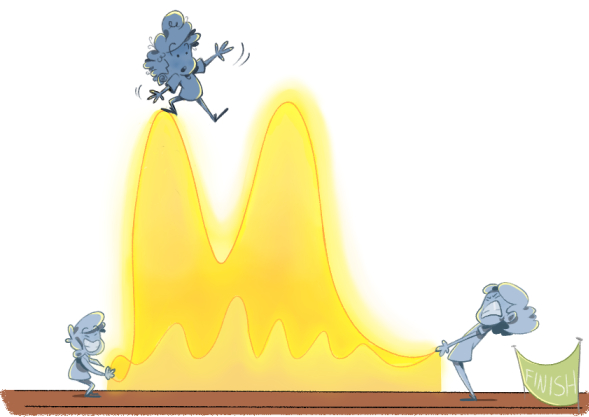
Feature Image: The Race of Inaccessibility, original illustration created by Peninnah Posey