
Behind Bars, Beyond Silence
The transformative power of theater, literature, and art in prison
—By Lily Miro
“I want to see if guerrilla theater could work with women prisoners,” a college professor told inmate Mary Heinen at the Detroit House of Corrections. Without hesitation, she replied, “Hell yeah, it could work. Let’s go.”
That first encounter with Dr. William Alexander, a University of Michigan professor, sparked a theater troupe inside the Detroit House of Corrections. Their debut performance, simply titled, The Show, was equal parts funny and political, including Heinen’s rant about President Bush’s Gulf War. The audience of incarcerated women loved it. The guards did not. After one actor played a guard so convincingly that it made guards in the back squirm, the entire troupe was shut down. But Heinen wasn’t deterred. She pleaded for another chance, re-formed the group, and kept the plays going. Thirty-six years later, Heinen is out of prison, but the tradition she helped start is still alive with the Prison Creative Arts Project (PCAP) at the University of Michigan.
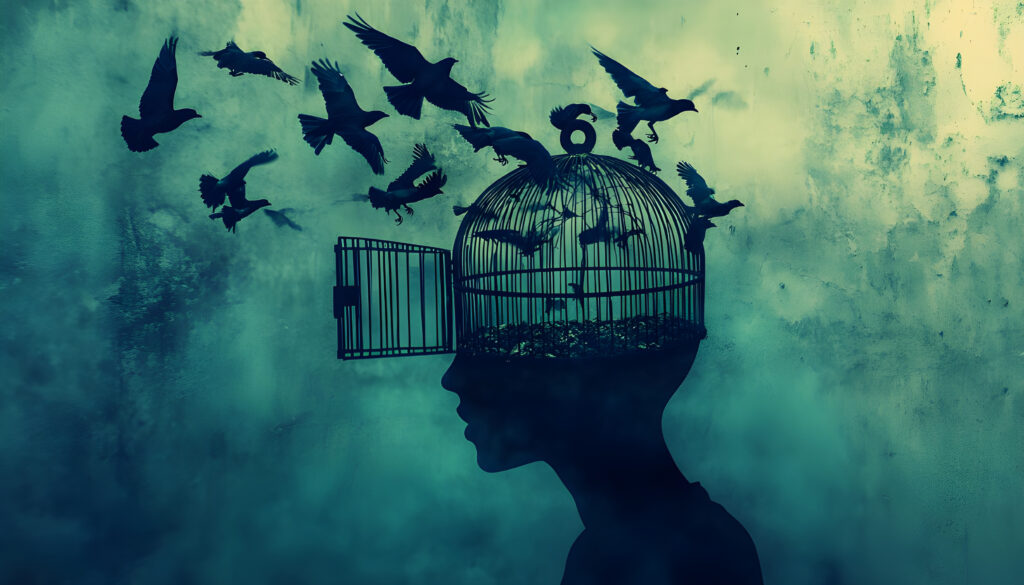
Mary Heinen’s story is one of many that illustrate the power of creativity behind bars. Across the country, incarcerated people use painting, reading, writing, theater, and music to resist invisibility and assert their humanity.
Theater as resistance
Mary Heinen is now the co-founder and program coordinator of PCAP, but she often reflects on her early experiences with theater in prison, recalling how skeptical many were of the potential for meaningful creative work in prison.
She remembers how, at the time, the idea that incarcerated individuals could produce thoughtful and influential art seemed almost revolutionary: “It used to be thought that prison art was just, you know, making popsicle stick houses and drawing little butterflies on envelopes,” she says. “They didn’t think that prisoners were as intelligent as they are and had the heart and soul that they have.”
For Heinen, prison art transcends entertainment, serving as a catalyst for personal and social transformation. Through theater, visual arts, and creative expression, incarcerated individuals are challenging assumptions and asserting their humanity in spaces designed to constrain it.
Building community through art
Ashley Lucas, a Professor of Theater & Drama at the University of Michigan and former director of PCAP, now serves as a faculty member supporting the program’s theater workshops and exhibitions. For her, the heart of this work lies in its ability to bring people together in an environment designed to do the opposite. “Prison is a place where it can be difficult to do things with other people,” Lucas explains. “It’s a place that’s meant to divide, meant to cultivate mistrust and antagonism.”
Social isolation is a dangerous reality in incarcerated settings. A 2024 Department of Justice Office of the Inspector General (OIG) report analyzed non-medical deaths in the Federal Bureau of Prisons (BOP) facilities from 2014-2021. The report found 344 deaths, more than half of which were suicides. Additionally, more than half of these suicides occurred in single-cell housing, highlighting the mental health risks of prolonged isolation. The report also noted systemic issues, including incomplete suicide risk assessments and inadequate staff wellness checks, underscoring ongoing challenges in protecting incarcerated individuals’ well-being.
This isolation is precisely why something as simple as gathering for a performance takes on such a weight in prison. Any play or concert requires a live audience, so in prison, the simple act of gathering becomes profound. “The fundamental core of what’s happening is to bring people together for meaningful engagement,” Lucas explains. “That is perhaps the highest stakes thing you can do in prison.”
For Lucas, the work is also deeply personal. “My father went to prison when I was 15 and spent 20 years in prisons in Texas,” she shared. Rather than distancing herself from the prison system that shaped both her and her dad’s lives, Lucas found purpose in returning to it through something she loved—art. “I was always a theater kid,” she explained. “What I really loved, what I still love, is the work with students and being in the prisons with the people we partner with there.” Lucas’s personal connection underscores the unique role that art programs play in humanizing incarcerated individuals and bridging gaps between communities inside and outside prison walls.
Reading as a lifeline
The power of literature behind bars is also a critical part of creative engagement within prisons. According to a 2016 BJS survey, the average person in state prison, who is 39 years old, has only a 10th-grade education. So, for incarcerated women, books can play a transformative role.
Megan Sweeney, a faculty member at the University of Michigan who has conducted extensive research on reading practices in women’s prisons, found that books provide both education and solace.
In Sweeney’s book, Reading Is My Window, she draws on her interviews with 94 women prisoners. These women all used reading in different ways, each speaking to their unique stories. One woman, after sustaining horrific violence in her life, “learned about tenderness through romance novels,” Sweeney explains. Other women turned to fast-paced urban fiction as a way to “keep up with the world outside.” Some took reading as a chance to “rewind the tape” and reflect on how they got caught up in money or drugs.
Reading was also a way for many of these women to connect with their kids by sharing the same stories across prison walls. Beyond words on the page, Sweeney explains how many women valued the “touch and feel of books,” with one woman choosing only paperbacks because they were “soft and comforting” in a place that can be hard and isolating. Sweeney explains how many of the female prisoners she interviewed talked about reading as “a lifeline” and “a tool for survival.”
One woman, Denise, found solace in Zora Neale Hurston’s Their Eyes Were Watching God. The novel spoke to her experiences of poverty, abuse, and grief, but it was a single moment that left its lasting mark. Denise had carried a lot of shame about wearing her prison tracksuit to her mother’s funeral. Then she remembered that Janie, Hurston’s protagonist, wore overalls even after the death of her lover, Tea Cake.
Sweeney explains that Denise felt “like there was someone, meaning Janie, who understood the level of her grief.” Janie’s resilience offered Denise a way to reframe her own experience, showing her that grief could run so deep “it wouldn’t matter what your clothes were.” For Denise and many others, literature offers not just stories, but connection, recognition, and relief.
Art as agency
Just like literature, art in prisons is about more than personal comfort; it’s a means of reclaiming agency. “Often when you’re incarcerated, the criminal justice system or the state is telling a story about you,” Nora Krinitsky, the current director of PCAP, explains. “Art is a really powerful way to challenge that purported authority and say, no, actually, there is another story here. I can speak.”
Art also provides a constant amid uncertainty, reminding people that growth is not confined by circumstance. As Krinitsky explains, “freedom is not the only measure of your potential.” Practices like reading, education, or art making can foster reflection and communication even within restrictive spaces. “Even literally using a pencil on notebook paper can activate self-reflection and communication,” Krinitsky says.
Challenges behind the scenes
Running a prison art program is not without its obstacles. Krinitsky notes that prisons often enforce rules arbitrarily, sometimes shifting them without warning as a way to exercise power. This unpredictability mirrors the broader reality of incarceration, where people live with limited agency under constantly changing rules.
Funding presents another persistent hurdle. With arts programs in prisons frequently considered non-essential, budget cuts and limited grant opportunities place additional strain on administrators. The Covid-19 pandemic intensified these challenges, causing staff shortages and program interruptions, while creating stricter restrictions on access to facilities. Bureaucratic layers, from federal and state departments to university oversight, add complexity to coordinating even the simplest workshops or exhibitions.
Despite these obstacles, the rewards of prison arts programs are undeniable. Krinitsky emphasizes the value of relationships formed across generations: “One thing I really value about my work at PCAP is I’ve established close intergenerational relationships … For students and volunteers, that’s really uncommon and incredibly valuable.” These relationships strengthen the programs’ impact, providing mentorship and meaningful engagement that benefit both incarcerated individuals and the students and volunteers who work with them.
The lasting impact
For Mary Heinen, Ashley Lucas, Megan Sweeney, Nora Krinitsky, and countless others, creativity in prison represents more than a pastime. It is a lifeline, a classroom, and a stage. It doesn’t erase the harm of incarceration, but it does carve out spaces of dignity, resistance, and possibility. It allows people to be seen as more than the sum of their sentences, reminding us that freedom can transcend prison walls.
From a simple romance novel that teaches tenderness to a theater troupe that sparked a decades-long movement of art and connection, it is clear that creative expression has the power to liberate, even in the face of confinement. As Mary Heinan puts it, “Social change is fueled by art. It’s gasoline. It’s what makes it run. It’s what creates beauty in the world.”
Feature photo by Oleksiy on stock.adobe.com